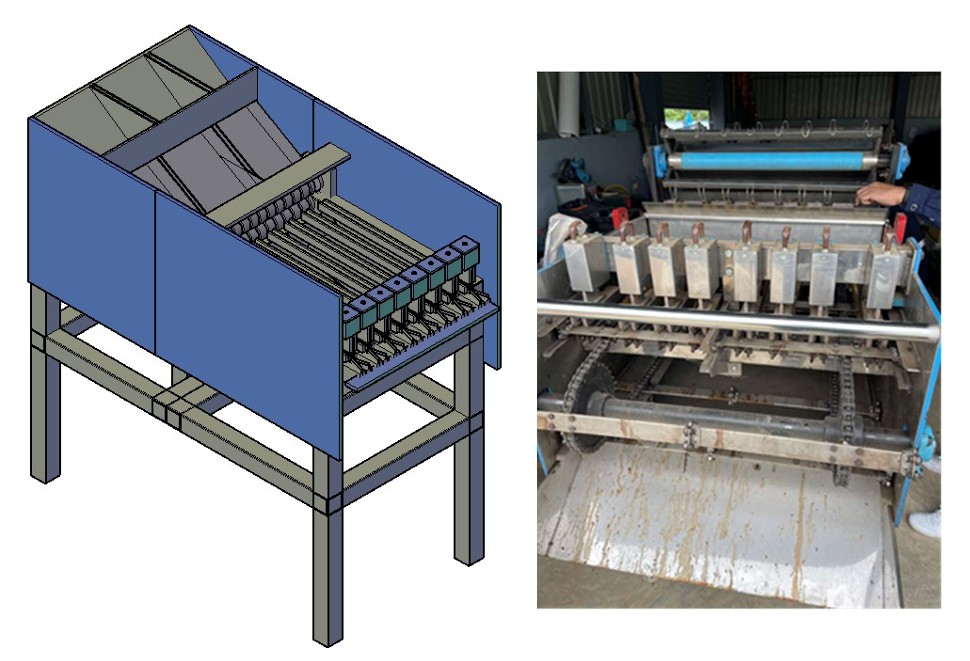
การพัฒนาเครื่องสีเม็ดมะม่วงหิมพานต์สำหรับการคัดแยกขนาดเพื่อการลดการสูญเสียจากการเสียดสี
คำสำคัญ:
มะม่วงหิมพานต์, เครื่องสีเม็ดมะม่วงหิมพานต์, การคัดแยกขนาด, การลดการสูญเสีย, วิศวกรรมเครื่องจักรกลเกษตรบทคัดย่อ
งานวิจัยนี้มีวัตถุประสงค์เพื่อศึกษาปัจจัยที่มีผลต่ออัตราการเกิดของเสียในกระบวนการสีเม็ดมะม่วงหิมพานต์ โดยใช้เครื่องสีและคัดแยกขนาดที่พัฒนาขึ้นเพื่อลดการสูญเสียจากกระบวนการผลิต กลุ่มตัวอย่างที่ใช้ในการทดลองคือเม็ดมะม่วงหิมพานต์ดิบที่จำแนกตามชั้นคุณภาพเป็น 3 เกรด ได้แก่ เกรด AA, เกรด A และเกรด B โดยใช้เม็ดมะม่วงหิมพานต์จำนวน 2,160 เม็ดต่อเกรด ภายใต้การออกแบบการทดลองจำนวน 18 เงื่อนไขทดลอง ทำซ้ำเงื่อนไขละ 6 ครั้ง และใช้ตัวอย่างครั้งละ 20 เม็ด ตัวแปรที่ศึกษา ได้แก่ ระยะห่างระหว่างใบมีด ความเร็วรางเลื่อน และมุมใบมีดก้างปลาตัวล่าง การออกแบบการทดลองอาศัยเทคนิคการออกแบบการทดลอง (Design of Experiments: DOE) และทำการวิเคราะห์ข้อมูลทางสถิติด้วยการวิเคราะห์ความแปรปรวนสองทาง (Two-Way Analysis of Variance: Two-Way ANOVA) เพื่อทดสอบผลของตัวแปรหลักและปฏิสัมพันธ์ของตัวแปรที่มีต่อปริมาณของเสีย เมื่อพบความแตกต่างอย่างมีนัยสำคัญทางสถิติ จึงทำการทดสอบความแตกต่างของปฏิกิริยาเดี่ยวและปฏิกิริยาร่วมเพิ่มเติม
ผลการวิจัยพบว่าปัจจัยที่มีผลต่ออัตราการเกิดของเสียในกระบวนการสีเม็ดมะม่วงหิมพานต์ โดยพิจารณาตัวแปร ได้แก่ ระยะห่างระหว่างใบมีด ความเร็วรางเลื่อน และมุมก้างปลา ผลการศึกษาพบว่า ระยะห่างระหว่างใบมีดและความเร็วรางเลื่อนเป็นตัวแปรที่ส่งผลต่อปริมาณของเสียในทุกเกรดไปในทิศทางเดียวกัน ขณะที่มุมก้างปลาตัวล่างไม่ส่งผลต่อปริมาณของเสียอย่างมีนัยสำคัญ ผลการทดสอบสมรรถนะการผลิตของเครื่องพบว่า เกรด AA ให้ผลผลิตใน 1 ชั่วโมงเท่ากับ 16.12 กิโลกรัม โดยเป็นเมล็ดสมบูรณ์ 12.76 กิโลกรัม และเมล็ดแตกหัก 3.36 กิโลกรัม เมื่อคำนวณในระยะเวลา 8 ชั่วโมง ได้ผลผลิตรวม 128.96 กิโลกรัม เป็นเมล็ดสมบูรณ์ 102.08 กิโลกรัม คิดเป็นร้อยละ 79.15 ซึ่งอยู่ในระดับดี ส่วนเกรด A (3 ช่อง) ให้ผลผลิตใน 1 ชั่วโมง 24.18 กิโลกรัม เป็นเมล็ดสมบูรณ์ 19.80 กิโลกรัม และเมล็ดแตกหัก 4.38 กิโลกรัม และใน 8 ชั่วโมงให้ผลผลิตรวม 193.44 กิโลกรัม เป็นเมล็ดสมบูรณ์ 158.40 กิโลกรัม คิดเป็นร้อยละ 81.88 จัดอยู่ในระดับดีเยี่ยม สำหรับเกรด B (3 ช่อง) ให้ผลผลิตรวมใน 8 ชั่วโมงเท่ากับ 193.44 กิโลกรัม เป็นเมล็ดสมบูรณ์ 153.12 กิโลกรัม คิดเป็นร้อยละ 79.15 อยู่ในระดับดี เมื่อเปรียบเทียบผลผลิต พบว่าเกรด A และ B ให้ผลผลิตรวมสูงกว่าเกรด AA เนื่องจากมีจำนวนรางเลื่อนมากกว่า อย่างไรก็ตาม เกรด A ให้ปริมาณเมล็ดสมบูรณ์สูงกว่าและมีเมล็ดแตกหักน้อยกว่าเกรด B แสดงให้เห็นว่า เกรด A เป็นขนาดที่ให้ประสิทธิภาพการผลิตโดยรวมดีที่สุดสำหรับเครื่องสีเม็ดมะม่วงหิมพานต์ที่ศึกษา.
เอกสารอ้างอิง
Singharat, P., & Therdwongworakul, A. (1999). Cashew nut shelling machine and cashew nut size grading machine. In Proceedings of the compilation of research abstracts by Thai university faculty members (1997–1999) (pp. 112–118). Bangkok, Thailand.
Adekunle, J. A. (2008). Physical properties of cashew nut relevant to processing. Journal of Food Engineering, 88(3), 390–394. https://doi.org/10.1016/j.jfoodeng.2008.02.006
Olukunle, O. J., & Akinnuli, B. O. (2012). Investigating some engineering properties of cashew nut for mechanization. Agricultural Engineering International: CIGR Journal, 14(2), 120–126.
Akinoso, R., & Raji, A. O. (2011). Physical properties of cashew nut as affected by moisture content. Journal of Food Process Engineering, 34(6), 1930–1942.
Amarit, S., Phaosanthatphanishsomdej, C., Thaita, T., & Thongchan, P. (2010). Research and development of a green husk macadamia nut shelling machine. Agricultural Engineering Research Institute, Department of Agriculture, Thailand.
Food and Agriculture Organization of the United Nations. (2018). Cashew processing handbook. FAO.
Ajayi, A. O., & Olajide, J. O. (2008). Mechanical properties of cashew nut relevant to shelling operation. Journal of Agricultural Engineering, 45(4), 201–208.
Olajide, J. O. (2000). Effect of moisture content on cracking characteristics of cashew nut. Journal of Agricultural Engineering Research, 76(3), 345–350.
Bamgboye, A. S., & Adejumo, O. A. (2006). Performance evaluation of a locally developed cashew nut sheller. Journal of Food Engineering, 76(3), 372–377.
Olukunle, O. J. (2005). Some physical properties of cashew nut relevant to shelling. Journal of Agricultural Engineering and Technology, 13(1), 17–25.
Adebayo, S. A. (2014). Development of a motorized cashew nut shelling machine. International Journal of Engineering Research and Technology, 3(5), 1125–1131.
Jain, R. K., & Bal, R. (2006). Design considerations for cashew nut shelling machines. Biosystems Engineering, 93(3), 313–320.
Borompichaitigul, C., Pichaibanditkul, B., & Chaiwong, W. (2007). Factors affecting macadamia nut shelling using compressive force. Thai Journal of Agricultural Science, 38(5, Special Issue), 349–352.
Saenyakul, S., & Wongtha, N. (2013). Macadamia nut shelling machine: Design and construction project. Rajamangala University of Technology Lanna, Thailand.
Phunikom, K. (2017). Process improvement in manufacturing efficiency using work improvement techniques: A case study of a drinking water factory (Master’s thesis). Ubon Ratchathani University, Thailand.
Benjasiriwan, K. (2008). Work study and logistics improvement in wooden furniture component manufacturing. Dhurakij Pundit University, Thailand.
Thiminkul, K. (2013). Research and development of agricultural machinery to increase the value of sunflower products. Department of Agriculture, Thailand.
Angkasith, P., & Warit, B. (1999). Integrated coffee production technology. Department of Agricultural Extension, Thailand.
Naka, P., et al. (2004). Coffee (Academic Document No. 17/2004). Department of Agriculture, Thailand.
Korkerd, J. (2019). Improvement of production processes using work study techniques: A case study of vegetarian pork rinds (Master’s thesis). Chiang Rai Rajabhat University, Thailand.
Phumipipat, W. (2017). Productivity improvement in manufacturing processes: A case study of a fermented rice noodle factory (Master’s thesis). Chiang Rai Rajabhat University, Thailand.
United Nations Industrial Development Organization. (2020). Agro-processing for cashew value chains. UNIDO.