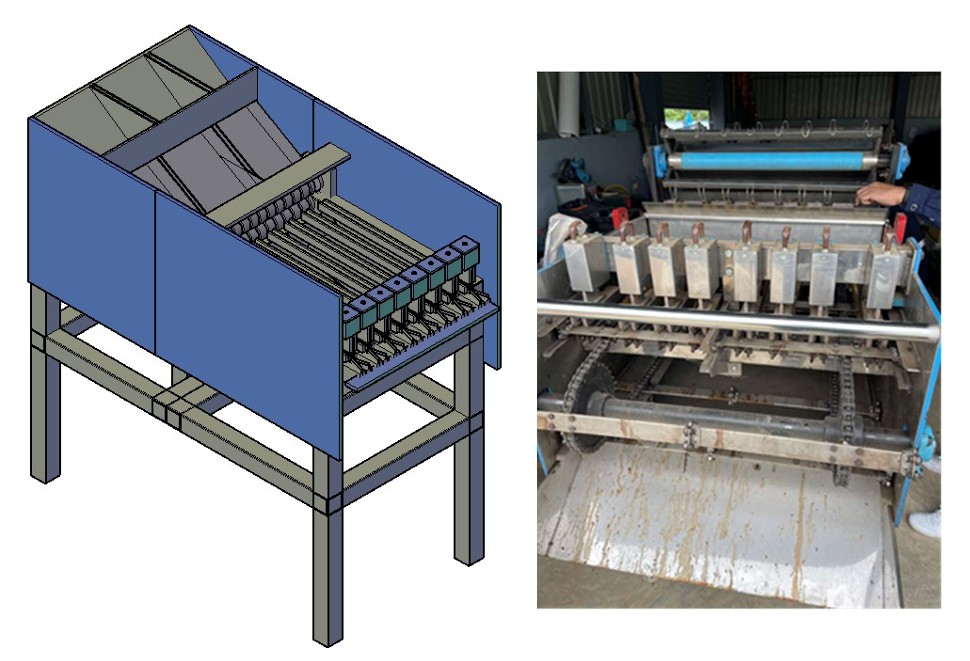
Development of a Cashew Nut Shelling and Size Grading Machine for Loss Reduction
Keywords:
Cashew Nut, Cashew Nut Peeling Machine, Size Grading, Loss Reduction, Agricultural Machinery EngineeringAbstract
This study investigates the factors influencing the waste generation rate in the cashew nut peeling process using a newly developed peeling and size-grading machine aimed at loss reduction. The experimental samples consisted of raw cashew nuts classified into three quality grades, namely Grade AA, Grade A, and Grade B. For each grade, a total of 2,160 nuts were tested, derived from a designed experimental scheme comprising 18 experimental conditions with six replications per condition and 20 nuts per replication. The examined operational variables included blade clearance, slider speed, and lower herringbone blade angle. The experimental design was based on the design of experiments (DOE) approach, and the collected data were statistically analyzed using two-way analysis of variance (Two-Way ANOVA) to evaluate the main effects and interaction effects of the operating parameters on waste generation. When statistically significant differences were detected, simple main effect and interaction analyses were subsequently performed.
The results indicate the factors influencing the waste generation rate in the cashew nut peeling process by examining key operational variables, including the blade clearance, slider speed, and herringbone angle. The results indicate that blade clearance and slider speed consistently affect the amount of waste across all grades in the same direction, whereas the lower herringbone angle does not have a statistically significant effect on waste generation. Performance evaluation of the peeling machine shows that Grade AA yields 16.12 kg, comprising 12.76 kg of whole kernels and 3.36 kg of broken kernels. When extrapolated to an 8-hour operating period, the total output reaches 128.96 kg, of which 102.08 kg are whole kernels, corresponding to 79.15%, which is classified as good quality. For Grade A (three channels), the machine produces 24.18 kg, including 19.80 kg of whole kernels and 4.38 kg of broken kernels. Over 8 hours, the total production amounts to 193.44 kg, with 158.40 kg of whole kernels, representing 81.88% and indicating excellent performance. Similarly, Grade B (three channels) achieves a total output of 193.44 kg over 8 hours, yielding 153.12 kg of whole kernels, or 79.15%, which is considered good quality. Comparative analysis reveals that Grades A and B achieve higher total production than Grade AA due to a greater number of sliding channels. However, Grade A provides a higher proportion of whole kernels and a lower fraction of broken kernels compared with Grade B. These results demonstrate that Grade A offers the best overall production efficiency for the cashew nut peeling machine investigated in this study.
References
Singharat, P., & Therdwongworakul, A. (1999). Cashew nut shelling machine and cashew nut size grading machine. In Proceedings of the compilation of research abstracts by Thai university faculty members (1997–1999) (pp. 112–118). Bangkok, Thailand.
Adekunle, J. A. (2008). Physical properties of cashew nut relevant to processing. Journal of Food Engineering, 88(3), 390–394. https://doi.org/10.1016/j.jfoodeng.2008.02.006
Olukunle, O. J., & Akinnuli, B. O. (2012). Investigating some engineering properties of cashew nut for mechanization. Agricultural Engineering International: CIGR Journal, 14(2), 120–126.
Akinoso, R., & Raji, A. O. (2011). Physical properties of cashew nut as affected by moisture content. Journal of Food Process Engineering, 34(6), 1930–1942.
Amarit, S., Phaosanthatphanishsomdej, C., Thaita, T., & Thongchan, P. (2010). Research and development of a green husk macadamia nut shelling machine. Agricultural Engineering Research Institute, Department of Agriculture, Thailand.
Food and Agriculture Organization of the United Nations. (2018). Cashew processing handbook. FAO.
Ajayi, A. O., & Olajide, J. O. (2008). Mechanical properties of cashew nut relevant to shelling operation. Journal of Agricultural Engineering, 45(4), 201–208.
Olajide, J. O. (2000). Effect of moisture content on cracking characteristics of cashew nut. Journal of Agricultural Engineering Research, 76(3), 345–350.
Bamgboye, A. S., & Adejumo, O. A. (2006). Performance evaluation of a locally developed cashew nut sheller. Journal of Food Engineering, 76(3), 372–377.
Olukunle, O. J. (2005). Some physical properties of cashew nut relevant to shelling. Journal of Agricultural Engineering and Technology, 13(1), 17–25.
Adebayo, S. A. (2014). Development of a motorized cashew nut shelling machine. International Journal of Engineering Research and Technology, 3(5), 1125–1131.
Jain, R. K., & Bal, R. (2006). Design considerations for cashew nut shelling machines. Biosystems Engineering, 93(3), 313–320.
Borompichaitigul, C., Pichaibanditkul, B., & Chaiwong, W. (2007). Factors affecting macadamia nut shelling using compressive force. Thai Journal of Agricultural Science, 38(5, Special Issue), 349–352.
Saenyakul, S., & Wongtha, N. (2013). Macadamia nut shelling machine: Design and construction project. Rajamangala University of Technology Lanna, Thailand.
Phunikom, K. (2017). Process improvement in manufacturing efficiency using work improvement techniques: A case study of a drinking water factory (Master’s thesis). Ubon Ratchathani University, Thailand.
Benjasiriwan, K. (2008). Work study and logistics improvement in wooden furniture component manufacturing. Dhurakij Pundit University, Thailand.
Thiminkul, K. (2013). Research and development of agricultural machinery to increase the value of sunflower products. Department of Agriculture, Thailand.
Angkasith, P., & Warit, B. (1999). Integrated coffee production technology. Department of Agricultural Extension, Thailand.
Naka, P., et al. (2004). Coffee (Academic Document No. 17/2004). Department of Agriculture, Thailand.
Korkerd, J. (2019). Improvement of production processes using work study techniques: A case study of vegetarian pork rinds (Master’s thesis). Chiang Rai Rajabhat University, Thailand.
Phumipipat, W. (2017). Productivity improvement in manufacturing processes: A case study of a fermented rice noodle factory (Master’s thesis). Chiang Rai Rajabhat University, Thailand.
United Nations Industrial Development Organization. (2020). Agro-processing for cashew value chains. UNIDO.