การวิเคราะห์ขีดความสามารถเชิงความร้อนและกลศาสตร์ของแขนจับยึดชิ้นงานเชื่อมแบบปรับตำแหน่งได้
คำสำคัญ:
ระเบียบวิธีไฟไนต์เอลิเมนต์ , ความเค้นทางความร้อน , พฤติกรรมทางกลศาสตร์ , การถ่ายเทความร้อน, แขนจับยึดชิ้นงานเชื่อมบทคัดย่อ
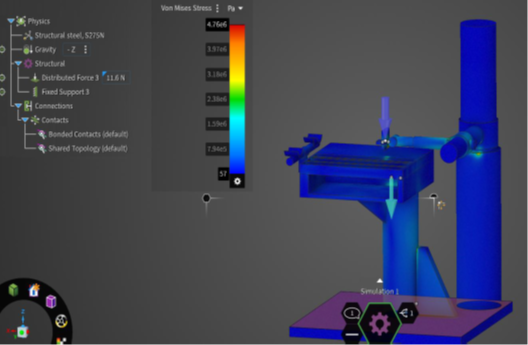
งานวิจัยนี้มีวัตถุประสงค์เพื่อวิเคราะห์ความสามารถเชิงโครงสร้างของแขนจับยึดชิ้นงานเชื่อมแบบปรับตำแหน่งได้ภายใต้ภาระทางกล และความร้อนร่วมกันโดยใช้ระเบียบวิธีไฟไนต์เอลิเมนต์แบบฟิสิกส์ร่วม (Coupled-field Finite Element Analysis) ด้วยโปรแกรม ANSYS ในการจำลองพฤติกรรมการรับแรง และการถ่ายเทความร้อนของโครงสร้างเหล็กกล้า S275 ภายใต้แรงกดแบบเยื้องศูนย์ขนาด 11.57 N และช่วงอุณหภูมิ 25 ถึง 450 °C พร้อมทวนสอบความแม่นยำด้วยการคำนวณเชิงทฤษฎีทางกลศาสตร์วิศวกรรมผลการวิเคราะห์พบว่าภายใต้ภาระทางกลเพียงอย่างเดียวที่อุณหภูมิห้องโครงสร้างมีความแข็งแรงสูงด้วยความเค้นเทียบเท่าวอนมิเซสสูงสุด 4.76 MPa และค่าความปลอดภัย 49.8 สำหรับการวิเคราะห์แบบฟิสิกส์ร่วมพบว่าความเค้นสะสมเพิ่มขึ้นอย่างรวดเร็วจาก 43.38 MPa ที่ 25 °C เป็น 364.45 MPa ที่ 450 °C ส่งผลให้ค่าความปลอดภัยลดลงจาก 6.34 ที่อุณหภูมิห้องเหลือ 1.63 ที่ 200 °C และลดลงต่ำกว่า 1.00 เมื่ออุณหภูมิสูงกว่าประมาณ 255 °C ที่อุณหภูมิ 300 °C โครงสร้างมีค่าความปลอดภัยเพียง 0.71 ซึ่งบ่งชี้ว่าเกิดการเสียรูปถาวรก่อนถึง 300 °C ผลการวิจัยยืนยันว่าภาระทางความร้อนเป็นปัจจัยกำหนดกลไกการวิบัติของอุปกรณ์จับยึดมากกว่าภาระทางกลการศึกษานี้จึงกำหนดขีดจำกัดอุณหภูมิเชิงปฏิบัติการไม่เกิน 250 °C เพื่อความปลอดภัยในการใช้งานพร้อมทั้งเสนอกรอบการวิเคราะห์ที่ผ่านการทวนสอบซึ่งสามารถลดความจำเป็นในการสร้างชิ้นงานต้นแบบทางกายภาพได้
เอกสารอ้างอิง
Da Rosa, A. F., Quintana, D. S., Marinho, R. R., Schwedersky, M. B., & Gonçalves e Silva, R. H. (2026). Stud welding process: A comprehensive literature review of fundamentals, recent advances, and industrial perspectives. The International Journal of Advanced Manufacturing Technology, 142(3), 1055–1097. https://doi.org/10.1007/s00170-025-17040-2
Zhao, S., Chen, J., & Chan, T.-M. (2026). Effect of welding on behaviours of high strength steel welded joints: A state-of-the-art review. Structures, 84, 111002. https://doi.org/10.1016/j.istruc.2025.111002
Wahidi, S. I., Oterkus, S., Oterkus, E., Supomo, H., & Pribadi, T. W. (2025). Structural optimisation for minimising weight and welding in confined shipbuilding spaces: Enhancing safety and reducing costs. Ocean Engineering, 341, 122779. https://doi.org/10.1016/j.oceaneng.2025.122779
Arnaoutis, V., Rosić, B. V., & Lutters, E. (2023). Parametric design evolution for production setups: A case study for welding fixtures. Procedia CIRP, 120, 1522–1527. https://doi.org/10.1016/j.procir.2023.09.208
Das, A., Kumar, A., Shankhwar, K., & Gubeljak, N. (2022). A review of heat source and resulting temperature distribution in arc welding. Journal of Thermal Analysis and Calorimetry, 147(23), 12975–13010. https://doi.org/10.1007/s10973-022-11589-w
Li, Y., Wang, M., Li, G., & Jiang, B. (2021). Mechanical properties of hot-rolled structural steels at elevated temperatures: A review. Fire Safety Journal, 119, 103237. https://doi.org/10.1016/j.firesaf.2020.103237
Khaongam, K., & Srihajong, N. (2015). Heat transfer characteristics of thermo-syphon: Case study of modifying inclination angle of evaporator and condenser sections. Food Agricultural Sciences and Technology, 1(2), 57–62. https://doi.org/10.14456/randk.2015.9
Muránsky, O., Smith, M. C., Bendeich, P. J., Holden, T. M., Luzin, V., Martins, R. V., & Edwards, L. (2012). Comprehensive numerical analysis of a three-pass bead-in-slot weld and its critical validation using neutron and synchrotron diffraction residual stress measurements. International Journal of Solids and Structures, 49(9), 1045–1062. https://doi.org/10.1016/j.ijsolstr.2011.07.006
Nie, L., He, D., Lei, W., Chen, D., Zhao, L., & Xiao, Q. (2026). A temperature-adaptive enhanced thermomechanical model for friction stir welding: Interfacial slip quantification, tool loads coupling, and asymmetric residual stress mechanism. Journal of Materials Research and Technology. https://doi.org/10.1016/j.jmrt.2026.02.011
Sun, Y., Zhu, Y., Jin, H., Wei, Y., Liu, X., Gao, Y., & Chu, J. (2025). Analysis of factors influencing stress and deformation in tungsten inert gas welding of complex thin-walled combustion liners via finite element model. Journal of Materials Engineering and Performance, 1–21. https://doi.org/10.1007/s11665-025-12833-8
Bercelli, L., Levieil, B., Doudard, C., Malek, B., Bridier, F., & Ezanno, A. (2023). Use of infrared thermography to model the effective stress ratio effect on fatigue crack growth in welded T-joints. Engineering Fracture Mechanics, 279, 109061. https://doi.org/10.1016/j.engfracmech.2023.109061
Venkatachari, S., & Kodur, V. (2023). Modeling parameters for predicting the fire-induced progressive collapse in steel framed buildings. Resilient Cities and Structures, 2(3), 129–144. https://doi.org/10.1016/j.rcns.2023.10.003
Anual, M., Sahroni, T., Akmal, S., & Nasution, F. (2018). Transient thermal analysis of welding fixtures design. IOP Conference Series: Earth and Environmental Science, 195(1), 012042. https://doi.org/10.1088/1755-1315/195/1/012042
Liu, C., & Zhang, J. (2009). Investigation of external restraining force effects on welding residual stresses using three-dimensional thermal elastic-plastic multi-body coupling finite element model. Proceedings of the Institution of Mechanical Engineers, Part B: Journal of Engineering Manufacture, 223(12), 1591–1600. https://doi.org/10.1243/09544054JEM1548
Gong, X., Cheng, G., Zhang, Q., Li, Z., & Nie, Y. (2025). Structural shakedown analysis considering temperature-dependent yield stress and varying thermomechanical loads based on data-driven FEM cluster-based basis reduction method. Engineering Structures, 341, 120815. https://doi.org/10.1016/j.engstruct.2025.120815
Khaongam, K., & Khampong, P. (2026). Experimental investigation of the heat transfer performance of a two-phase closed thermosyphon under different inclination angles and filling ratios using dimensionless analysis. Journal of Industrial Technology Buriram Rajabhat University, 8(1), 29–56. https://doi.org/10.14456/brujit.2026.3
Kelly, F., & Sha, W. (1999). A comparison of the mechanical properties of fire-resistant and S275 structural steels. Journal of Constructional Steel Research, 50(3), 223–233. https://doi.org/10.1016/S0143-974X(98)00252-1
Outinen, J., & Mäkeläinen, P. (2004). Mechanical properties of structural steel at elevated temperatures and after cooling down. Fire and Materials, 28(2–4), 237–251. https://doi.org/10.1002/fam.849
Kim, H. J., Lee, C.-H., Cho, Y., & Park, M. J. (2025). Post-fire residual yield strength and ultimate strength of structural steel SS275 considering load ratios. Journal of Constructional Steel Research, 234, 109745. https://doi.org/10.1016/j.jcsr.2025.109745
Bijlaard, F. (2008). Eurocode 3: Design of steel structures—Present status and further developments. Steel Construction, 1(1), 16–23. https://doi.org/10.1002/stco.200890000
Torić, N., Harapin, A., & Boko, I. (2015). Modelling of the influence of creep strains on the fire response of stationary heated steel members. Journal of Structural Fire Engineering, 6(3), 155–176. https://doi.org/10.1260/2040-2317.6.3.155
Thanoi, K., Naksungnoen, W., Buapa, P., & Khaongam, K. (2026). Development of a hydraulic press-based flat steel bar cutting system. Journal of Industrial Technology Buriram Rajabhat University, 8(1), 13–28. https://doi.org/10.14456/brujit.2026.2
Meriam, J. L., Kraige, L. G., & Bolton, J. N. (1975). Statics. Wiley.
Pytel, A., & Kiusalaas, J. (2012). Mechanics of materials. Cengage Learning.
Bhandari, V. (2010). Design of machine elements. Tata McGraw-Hill Education.
Callister, W. D., Jr., & Rethwisch, D. G. (2020). Materials science and engineering: An introduction. John Wiley & Sons.
Martyushev, S., & Dement'Ev, A. (2018). Three-dimensional modelling of external mechanical effects on devices and machinery in SolidWorks Simulation. Siberian Journal of Science and Technology, 19(1), 82–97. https://doi.org/10.31772/2587-6066-2018-19-1-82-97
Boley, B. A., & Weiner, J. H. (2012). Theory of thermal stresses. Courier Corporation.
Khaongam, K., Chompookham, T., & Parametthanuwat, T. (2025). Internal flow pattern of the condenser section that affects the heat transfer characteristics of rectangular two-phase closed thermosyphon. Case Studies in Thermal Engineering, 72, 106246. https://doi.org/10.1016/j.csite.2025.106246
Bergman, T. L. (2011). Fundamentals of heat and mass transfer. John Wiley & Sons.
Khaongam, K., Srihajong, N., Seahang, K., & Pratoomchat, P. (2014). Thermal performance of closed-loop oscillating heat pipes with check valves using AgNO₃/distilled water nanofluids. In The 6th International Conference on Science, Technology and Innovation for Sustainable Well-Being (STISWB VI 2014).https://doi.org/10.13140/RG.2.2.33101.74728
Abambres, M., & Arruda, M. R. (2016). Finite element analysis of steel structures—A review of useful guidelines. International Journal of Structural Integrity, 7(4), 490–515. https://doi.org/10.1108/IJSI-07-2015-0020
Bezerra, A. C., Rade, D. A., & Scotti, A. (2005). Finite element simulation of TIG welding: Thermal analysis. In Proceedings of the 18th International Congress of Mechanical Engineering.
Pantousa, D., & Karavasilis, T. (2021). Experimental and numerical investigation of the ductile fracture of structural steel at elevated temperatures. Journal of Constructional Steel Research, 177, 106444. https://doi.org/10.1016/j.jcsr.2020.106444
Zhang, W., Yang, Q., Yin, P., Zhang, G., Xia, X., Zhao, Y., & Zhou, C. (2022). Thermomechanical fatigue and fracture behaviours of welded joints at various temperatures. Engineering Fracture Mechanics, 271, 108644. https://doi.org/10.1016/j.engfracmech.2022.108644