Development of a Guiding Cane for the Safety of the Visually Impaired
Keywords:
guiding cane, visually impaired, ultrasonic sensor, microcontroller, vibration system and buzzerAbstract
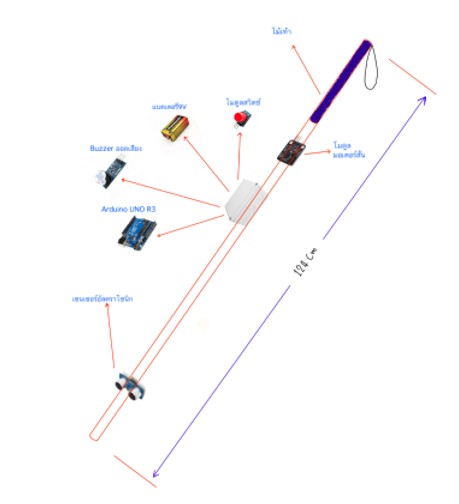
The research titled Guiding Cane for the Safety of the Visually Impaired aims to design and develop a cane capable of accurately detecting obstacles by integrating microcontroller technology with ultrasonic sensors, a vibration system, and a buzzer. The system is designed to enhance safety and confidence for visually impaired individuals during mobility. The Arduino Uno R3 board serves as the main controller for signal processing and operation of the alert components.
Experimental testing of the ultrasonic sensor was conducted 30 times. The results showed that the sensor successfully detected obstacles in every trial, achieving 100% accuracy, with both sound and vibration alerts responding effectively. These findings indicate that the developed cane performs efficiently, demonstrating high stability and reliability suitable for real-world applications in assisting the visually impaired.
In conclusion, the developed guiding cane successfully meets the research objectives in terms of design, functionality, and performance. Future improvements may include integrating additional sensors for omnidirectional detection, enhancing the alert system to distinguish obstacle distances more precisely, and incorporating technologies such as GPS or wireless connectivity to further increase usability and improve the quality of life for visually impaired individuals.
References
ทรงศักดิ์ รักพ่วง และภุชงค์ เสนานุช. (2562). นวัตกรรมทางสังคมสำหรับผู้สูงอายุ: ความสำคัญต่อสังคมผู้สูงอายุในประเทศไทย. วารสารวิชาการนวัตกรรมสื่อสารสังคม, 7(2), 205-215.
โสภิดา ท้วมมี, หทัยรัตน์ เกตุมณีชัยรัตน์, ฌลัลิกา เพชรมณีนิลใส และ พศวัต พันธ์โสตถ. (2565). ไม้เท้าอัจฉริยะสำหรับช่วยเหลือผู้พิการทางสายตา. วารสารวิชาการเทคโนโลยีอุตสาหกรรม, 10(2), 22-39.
วดีนาถ วรรณสวัสดิ์กุล. (2568). ไม้เท้าอัจฉริยะด้วยเทคโนโลยีอินเตอร์เน็ตของทุกสรรพสิ่งและปัญญาประดิษฐ์ในการตรวจจับสิ่งกีดขวาง. วารสารวิชาการเทคโนโลยีอุตสาหกรรม มหาวิทยาลัยราชภัฏสุรินทร์, 10(2), 213–224.
Wahab, M. H. A., Talib, A. A., Kadir, H. A., Johari, A., Noraziah, A., Sidek, R. M., & Mutalib, A. A. (2011). Smart Cane: Assistive Cane for Visually-impaired People. IJCSI International Journal of Computer Science Issues, 8(4), 2, 21-27.
Shiizu, Y., Hirahara, Y., Yanashima, K., & Magatani, K. (2007). The development of a white cane which navigates the visually impaired. In Proceedings of the 29th Annual International Conference of the IEEE EMBS (pp. 1-10). 23–26 August, 2007, Lyon, France.
Yang, C.-M., Jung, J.-Y., & Kim, J.-J. (2021). Development of Walking Assistive Cane for Obstacle Detection and Location Recognition for Visually Impaired People. Sensors and Materials, 33(10), 3623–3633.
อธิบดี มหาวัน, กฤตคม ศรีจิรานนท์ และนัฐชยพงศ์ ธีรัชตระกูล. (2565). วอคอะโก: ไม้เท้าอเนกประสงค์สำหรับช่วยเหลือและติดตามผู้ใช้งานผ่านแอปพลิเคชันไลน์. วารสารวิทยาศาสตร์และเทคโนโลยีแห่งรัตนโกสินทร์, 4(2), 10-18.
ธนพล แก้วคำแจ้ง, กัมปนาท บุญคง, ภาณุวัฒน์ ศิลาคะจิ และ นิติพัทธ์ บัวเก่า. (2563). การศึกษาความพึงพอใจไม้เท้าของผู้สูงวัยแจ้งเตือนผ่านทางไลน์แอพพลิเคชั่น. วารสารวิจัยและนวัตกรรมการอาชีวศึกษา, 4(1), 29-37.
สุปาณี พุกแก้ว. (2567). การใช้เทคโนโลยีสิ่งอำนวยความสะดวกในการเดินทางของคนพิการทางการเห็น: กรณีศึกษาสมาชิกสมาคมคนตาบอดแห่งประเทศไทย. วารสารวิจัยสังคมและปริทัศน์, 46(1), 1–23.