Thermo-Mechanical Capability Analysis of an Adjustable Positioning Clamping Arm for Welding Workpieces
Keywords:
Finite Element Analysis, Thermal Stress, Mechanical Behavior, Heat Transfer, Welding Workpiece Clamping ArmAbstract
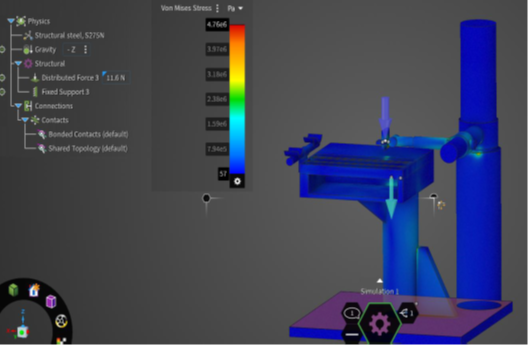
The purpose of the current research is to examine the structural capacity of a clamping arm that helps position a workpiece in the welding operation when subjected to mechanical and thermal loads, which can be adjusted. The coupled field finite element simulation was carried out on S275 structural steel using ANSYS software by subjecting the material to an eccentric compression force of 11.57 N while varying the temperature within the range of 25-450 °C. The accuracy of the proposed model was confirmed using theoretical predictions based on engineering mechanics. It has been observed that in the presence of mechanical load, it exhibits extremely high capacity with maximum Von Mises equivalent stress of 4.76 MPa and factor of safety (F.S.) of 49.8 at room temperature. According to the coupled-field analysis, it can be stated that the stress level rises from 43.38 MPa at 25 °C to 364.45 MPa at 450 °C, leading to a decrease in factor of safety from 6.34 at room temperature to 1.63 at 200 °C and becomes less than 1.00 if the temperature is above around 255 °C. At 300 °C, the F.S. becomes 0.71, hence plastic collapse takes place even before reaching 300 °C. It has been observed that the failure of the device is caused mainly by thermal loading and not mechanical loading. It thus provides the upper limit of operating temperature as 250 °C and safety definitions for industrial purposes, and the analytical framework too, which are validated and minimize the need for fabricating prototype specimens.
References
Da Rosa, A. F., Quintana, D. S., Marinho, R. R., Schwedersky, M. B., & Gonçalves e Silva, R. H. (2026). Stud welding process: A comprehensive literature review of fundamentals, recent advances, and industrial perspectives. The International Journal of Advanced Manufacturing Technology, 142(3), 1055–1097. https://doi.org/10.1007/s00170-025-17040-2
Zhao, S., Chen, J., & Chan, T.-M. (2026). Effect of welding on behaviours of high strength steel welded joints: A state-of-the-art review. Structures, 84, 111002. https://doi.org/10.1016/j.istruc.2025.111002
Wahidi, S. I., Oterkus, S., Oterkus, E., Supomo, H., & Pribadi, T. W. (2025). Structural optimisation for minimising weight and welding in confined shipbuilding spaces: Enhancing safety and reducing costs. Ocean Engineering, 341, 122779. https://doi.org/10.1016/j.oceaneng.2025.122779
Arnaoutis, V., Rosić, B. V., & Lutters, E. (2023). Parametric design evolution for production setups: A case study for welding fixtures. Procedia CIRP, 120, 1522–1527. https://doi.org/10.1016/j.procir.2023.09.208
Das, A., Kumar, A., Shankhwar, K., & Gubeljak, N. (2022). A review of heat source and resulting temperature distribution in arc welding. Journal of Thermal Analysis and Calorimetry, 147(23), 12975–13010. https://doi.org/10.1007/s10973-022-11589-w
Li, Y., Wang, M., Li, G., & Jiang, B. (2021). Mechanical properties of hot-rolled structural steels at elevated temperatures: A review. Fire Safety Journal, 119, 103237. https://doi.org/10.1016/j.firesaf.2020.103237
Khaongam, K., & Srihajong, N. (2015). Heat transfer characteristics of thermo-syphon: Case study of modifying inclination angle of evaporator and condenser sections. Food Agricultural Sciences and Technology, 1(2), 57–62. https://doi.org/10.14456/randk.2015.9
Muránsky, O., Smith, M. C., Bendeich, P. J., Holden, T. M., Luzin, V., Martins, R. V., & Edwards, L. (2012). Comprehensive numerical analysis of a three-pass bead-in-slot weld and its critical validation using neutron and synchrotron diffraction residual stress measurements. International Journal of Solids and Structures, 49(9), 1045–1062. https://doi.org/10.1016/j.ijsolstr.2011.07.006
Nie, L., He, D., Lei, W., Chen, D., Zhao, L., & Xiao, Q. (2026). A temperature-adaptive enhanced thermomechanical model for friction stir welding: Interfacial slip quantification, tool loads coupling, and asymmetric residual stress mechanism. Journal of Materials Research and Technology. https://doi.org/10.1016/j.jmrt.2026.02.011
Sun, Y., Zhu, Y., Jin, H., Wei, Y., Liu, X., Gao, Y., & Chu, J. (2025). Analysis of factors influencing stress and deformation in tungsten inert gas welding of complex thin-walled combustion liners via finite element model. Journal of Materials Engineering and Performance, 1–21. https://doi.org/10.1007/s11665-025-12833-8
Bercelli, L., Levieil, B., Doudard, C., Malek, B., Bridier, F., & Ezanno, A. (2023). Use of infrared thermography to model the effective stress ratio effect on fatigue crack growth in welded T-joints. Engineering Fracture Mechanics, 279, 109061. https://doi.org/10.1016/j.engfracmech.2023.109061
Venkatachari, S., & Kodur, V. (2023). Modeling parameters for predicting the fire-induced progressive collapse in steel framed buildings. Resilient Cities and Structures, 2(3), 129–144. https://doi.org/10.1016/j.rcns.2023.10.003
Anual, M., Sahroni, T., Akmal, S., & Nasution, F. (2018). Transient thermal analysis of welding fixtures design. IOP Conference Series: Earth and Environmental Science, 195(1), 012042. https://doi.org/10.1088/1755-1315/195/1/012042
Liu, C., & Zhang, J. (2009). Investigation of external restraining force effects on welding residual stresses using three-dimensional thermal elastic-plastic multi-body coupling finite element model. Proceedings of the Institution of Mechanical Engineers, Part B: Journal of Engineering Manufacture, 223(12), 1591–1600. https://doi.org/10.1243/09544054JEM1548
Gong, X., Cheng, G., Zhang, Q., Li, Z., & Nie, Y. (2025). Structural shakedown analysis considering temperature-dependent yield stress and varying thermomechanical loads based on data-driven FEM cluster-based basis reduction method. Engineering Structures, 341, 120815. https://doi.org/10.1016/j.engstruct.2025.120815
Khaongam, K., & Khampong, P. (2026). Experimental investigation of the heat transfer performance of a two-phase closed thermosyphon under different inclination angles and filling ratios using dimensionless analysis. Journal of Industrial Technology Buriram Rajabhat University, 8(1), 29–56. https://doi.org/10.14456/brujit.2026.3
Kelly, F., & Sha, W. (1999). A comparison of the mechanical properties of fire-resistant and S275 structural steels. Journal of Constructional Steel Research, 50(3), 223–233. https://doi.org/10.1016/S0143-974X(98)00252-1
Outinen, J., & Mäkeläinen, P. (2004). Mechanical properties of structural steel at elevated temperatures and after cooling down. Fire and Materials, 28(2–4), 237–251. https://doi.org/10.1002/fam.849
Kim, H. J., Lee, C.-H., Cho, Y., & Park, M. J. (2025). Post-fire residual yield strength and ultimate strength of structural steel SS275 considering load ratios. Journal of Constructional Steel Research, 234, 109745. https://doi.org/10.1016/j.jcsr.2025.109745
Bijlaard, F. (2008). Eurocode 3: Design of steel structures—Present status and further developments. Steel Construction, 1(1), 16–23. https://doi.org/10.1002/stco.200890000
Torić, N., Harapin, A., & Boko, I. (2015). Modelling of the influence of creep strains on the fire response of stationary heated steel members. Journal of Structural Fire Engineering, 6(3), 155–176. https://doi.org/10.1260/2040-2317.6.3.155
Thanoi, K., Naksungnoen, W., Buapa, P., & Khaongam, K. (2026). Development of a hydraulic press-based flat steel bar cutting system. Journal of Industrial Technology Buriram Rajabhat University, 8(1), 13–28. https://doi.org/10.14456/brujit.2026.2
Meriam, J. L., Kraige, L. G., & Bolton, J. N. (1975). Statics. Wiley.
Pytel, A., & Kiusalaas, J. (2012). Mechanics of materials. Cengage Learning.
Bhandari, V. (2010). Design of machine elements. Tata McGraw-Hill Education.
Callister, W. D., Jr., & Rethwisch, D. G. (2020). Materials science and engineering: An introduction. John Wiley & Sons.
Martyushev, S., & Dement'Ev, A. (2018). Three-dimensional modelling of external mechanical effects on devices and machinery in SolidWorks Simulation. Siberian Journal of Science and Technology, 19(1), 82–97. https://doi.org/10.31772/2587-6066-2018-19-1-82-97
Boley, B. A., & Weiner, J. H. (2012). Theory of thermal stresses. Courier Corporation.
Khaongam, K., Chompookham, T., & Parametthanuwat, T. (2025). Internal flow pattern of the condenser section that affects the heat transfer characteristics of rectangular two-phase closed thermosyphon. Case Studies in Thermal Engineering, 72, 106246. https://doi.org/10.1016/j.csite.2025.106246
Bergman, T. L. (2011). Fundamentals of heat and mass transfer. John Wiley & Sons.
Khaongam, K., Srihajong, N., Seahang, K., & Pratoomchat, P. (2014). Thermal performance of closed-loop oscillating heat pipes with check valves using AgNO₃/distilled water nanofluids. In The 6th International Conference on Science, Technology and Innovation for Sustainable Well-Being (STISWB VI 2014).https://doi.org/10.13140/RG.2.2.33101.74728
Abambres, M., & Arruda, M. R. (2016). Finite element analysis of steel structures—A review of useful guidelines. International Journal of Structural Integrity, 7(4), 490–515. https://doi.org/10.1108/IJSI-07-2015-0020
Bezerra, A. C., Rade, D. A., & Scotti, A. (2005). Finite element simulation of TIG welding: Thermal analysis. In Proceedings of the 18th International Congress of Mechanical Engineering.
Pantousa, D., & Karavasilis, T. (2021). Experimental and numerical investigation of the ductile fracture of structural steel at elevated temperatures. Journal of Constructional Steel Research, 177, 106444. https://doi.org/10.1016/j.jcsr.2020.106444
Zhang, W., Yang, Q., Yin, P., Zhang, G., Xia, X., Zhao, Y., & Zhou, C. (2022). Thermomechanical fatigue and fracture behaviours of welded joints at various temperatures. Engineering Fracture Mechanics, 271, 108644. https://doi.org/10.1016/j.engfracmech.2022.108644