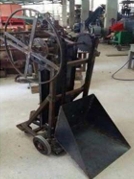
Development of A Semi-Automatic Garbage Cart for Community
Keywords:
Development, Garbage Cart, A Semi-Automatic, CommunityAbstract
This research aims 1) to develop a semi-automatic garbage cart for use in BanGlanta community, Glanta Subdistrict, Mueang District, Buriram Province. 2) To compare the efficiency of the newly developed a semi-automatic garbage cart with original. And 3) to find the economic value of a semi-automatic garbage cart and find the satisfaction with the use of a semi-automatic garbage cart of the user.The results showed that the new type of a semi-automatic garbage cart is efficient in working, can reduce the time to collect 1 kilogram of plastic bottles from 15.36 minutes to 14.57 minutes, decreasing 0.79 minutes (5.14 percent). The time to collect 1 kilogram of leaves could be reduced from 20.44 minutes to 18.35 minutes, decreasing 2.09 minutes (10.22 percent). Time to collect 1 kilogram of plastic scraps from 18.39 minutes to 16.45 minutes reduced to 1.94 minutes (10.55 percent). Can reduce the time to store 1 kilogram cans from 15.41 minutes to 14.55 minutes, reduced by 0.86 minutes (5.58 percent). Results of the analysis show that users are satisfied with the structure. With an average of 3.80 in terms of usage with an average of 4.20 and values with an average of 3.80. Therefore, in summary, the overall satisfaction of all users of the 3-sided a Semi-Automatic Garbage Cart in the overall has an average of 3.94 (78.80 percent). When analyzing the economic break-even point, found that 1 device must be sold in order to breakeven.
References
กรมควบคุมมลพิษ. “การจัดการขยะมูลฝอยชุมชนอย่างครบวงจร.” กรุงเทพมหานคร, 2562.
เทศบาลตําบลกลันทา. “ข้อมูลด้านสิ่งแวดล้อมและทรัพยากรธรรมชาติในเขตเทศบาลตําบลกลันทา.” บุรีรัมย์ : เรวัตการพิมพ์, 2561.
วุฒิวัฒน์ สมบูรณ์ และคณะ. “รถเก็บใบไม้แห้งพลังงานแสงอาทิตย์.” ปริญญาวิศวกรรมศาสตรบัณฑิตสาขาวิชาวิศวกรรมไฟฟ้า คณะวิศวกรรมศาสตร์ มหาวิทยาลัยศรีปทุม, กรุงเทพมหานคร. 2561.
ปรียาภรณ์ ศรีบุญเพ็ง และคณะ. “การพัฒนาเครื่องรวบรวมเศษหญ้าที ่ถูกตัดแล้วบนหญ้า.” ภาควิชาวิศวกรรมเกษตร คณะวิศวกรรมศาสตร์กําแพงแสน, นครปฐม. 2553.
ไกรสร รวยป้อม และคณะ. “เครื่องเก็บขยะต่อพ่วงท้ายรถแทรกเตอร์ขนาดเล็ก.” ปริญญาวิศวกรรมศาสตรบัณฑิต สาขาวิชาวิศวกรรมไฟฟ้า คณะวิศวกรรมศาสตร์ มหาวิทยาลัยศรีปทุม, กรุงเทพมหานคร. 2555.
ไตรรงค์ วิทยาคมและคณะ. “การพัฒนาเครื่องดูดใบไม้ระบบสุญญากาศ.” วิทยานิพนธ์วิศวกรรมศาสตรมหาบัณฑิต สาขาวิศวกรรมโยธา คณะวิศวกรรมศาสตร์ มหาวิทยาลัยเทคโนโลยีสุรนารี, นครราชสีมา. 2556.
กุศล ประกอบการ. “รถพ่วงเก็บขยะชายหาด.” วารสารวิทยาศาสตร์และเทคโนโลยี. ปีที่ 19, ฉบับที่ 1, 2559, หน้า 73-80.
ทัศนเทพ อาจหยุด. “รถเข็นกวาดขยะแปรงกวาดแบบรัศมี.” วิทยานิพนธ์วิศวกรรมศาสตรมหาบัณฑิตสาขาวิศวกรรมโยธา คณะวิศวกรรมศาสตร์ มหาวิทยาลัยเทคโนโลยีสุรนารี, นครราชสีมา. 2559.