Development of a Hydraulic Press-Based Flat Steel Bar Cutting System
Keywords:
Hydraulic press, Flat steel bar cutting, Conveyor-assisted feeding system, Cutting accuracy, Process capability (Cp, Cpk)Abstract
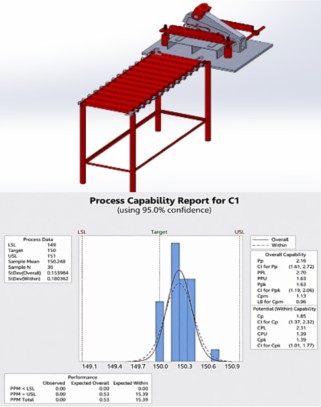
The aim of this research is to overcome the problem of delay and non-uniform quality in the cutting of flat steel bars by hydraulic press, due to the inefficient traditional process of feeding the steel bar to the hydraulic press. So a conveyor rail system to convey flat steel bars along with the hydraulic press was developed and designed to boost the cutting speed and precision. The research method was to build a prototype for the conveyor rail system and test it to see the difference in cutting performance between the conveyor rail and no conveyor rail, as well as the cutting time and the accuracy of the workpieces. The experimental results indicated that the developed system could cut the cutting time of the flat steel bars with a thickness of 9 mm from 8.6 s/piece (before development) to 3.8 s/piece (after improvement), which is an improvement of 55.81% efficiency. The accuracy of the workpieces with thicknesses of 3, 6 and 9 mm and a target 150 mm, showed average size of 150.2, 150.1, and 150.2 mm, respectively, with a tolerance of up to 1 mm, and an average squareness of about 90° with a tolerance of up to 1°. In addition, the results of the process capability analysis using a computer program showed that the values of Cp (process capability index) and Cpk (process capability index adjusted for actual position) for thicknesses of 3, 6 and 9 mm were 1.85/1.39, 1.95/1.60 and 3.30/2.26 respectively, all of which are superior to the industrial standard of 1.33. The results of the research validate the developed conveyor rail system which can enhance the production efficiency, ensure quality control and can be applied in real industrial conditions.
References
Benić, J., Brezak, D., Šitum, Ž., Kolar, D., & Lisjak, D. (2023). Detailed experimental comparison of energy efficiency between proportional and direct driven hydraulic system. Results in Engineering, 18, 101178. https://doi.org/10.1016/j.rineng.2023.101178
Sanchez-Marquez, R., & Jabaloyes Vivas, J. (2021). Building a C control chart: A novel and practical method for practitioners. Computers & Industrial Engineering, 158, 107428. https://doi.org/10.1016/j.cie.2021.107428
Huang, Z., Xu, Y., Ren, W., Fu, C., Cao, R., Kong, X., & Li, W. (2022). Design of position control method for pump-controlled hydraulic presses via adaptive integral robust control. Processes, 10(1), 14. https://doi.org/10.3390/pr10010014
Thummala, C., Sawatdee, R., & Phontip, S. (2019). Design and construction of a flat steel bar cutting machine applied by a hydraulic press machine. Rajamangala University of Technology Isan, Khon Kaen Campus. (in Thai)
Li, L., Chen, H., Jin, R., Xu, Y., Liu, Q., Li, G., & Huang, H. (2024). Independent metering-based leveling system with multi-actuator for energy saving: Modeling, control, and application on large-size forming equipment. Energy Conversion and Management, 302, 118119. https://doi.org/10.1016/j.enconman.2024.118119
Zhang, S., & Xia, X. (2011). Modeling and energy efficiency optimization of belt conveyors. Applied Energy, 88(9), 3061–3071. https://doi.org/10.1016/j.apenergy.2011.03.015
Yu, B., Xie, N., Zheng, B., & Chen, D. (2019). Methodology and decentralised control of modularised changeable conveyor logistics system. International Journal of Computer Integrated Manufacturing, 32(8), 739–749.
Wang, C.-N., Hsu, H.-P., & Tran, V.-V. (2017). An improved dispatching method (a-HPDB) for automated material handling system with active rolling belt for 450 mm wafer fabrication. Applied Sciences, 7(8), 780. https://doi.org/10.3390/app7080780
Borucka, A., Kozłowski, E., Antosz, K., & Parczewski, R. (2023). A new approach to production process capability assessment for non-normal data. Applied Sciences, 13(11), 6721. https://doi.org/10.3390/app13116721
Sandin, O., Rodríguez, J. M., Larour, P., Parareda, S., Frómeta, D., Hammarberg, S., … Casellas, D. (2024). A particle finite element method approach to model shear cutting of high-strength steel sheets. Computational Particle Mechanics, 11(5), 1863–1886. https://doi.org/10.1007/s40571-023-00708-5
Liu, K.-F., Jin, T., Shang, Z.-T., & Wang, H. (2024). Neural adaptive dynamic surface control of an electro-hydraulic loading system for rail grinders. Nonlinear Dynamics, 112(16), 14191–14213. https://doi.org/10.1007/s11071-024-09808-0
Ruane, P., Walsh, P., & Cosgrove, J. (2022). Development of a digital model and metamodel to improve the performance of an automated manufacturing line. Journal of Manufacturing Systems, 65, 538–549. https://doi.org/10.1016/j.jmsy.2022.10.011
de-Felipe, D., & Benedito, E. (2017). A review of univariate and multivariate process capability indices. The International Journal of Advanced Manufacturing Technology, 92(5), 1687–1705. https://doi.org/10.1007/s00170-017-0273-6
Montgomery, D. C. (2020). Introduction to statistical quality control. John Wiley & Sons.
Sanchez-Marquez, R., & Jabaloyes Vivas, J. (2021). Building a Cpk control chart: A novel and practical method for practitioners. Computers & Industrial Engineering, 158, 107428. https://doi.org/10.1016/j.cie.2021.107428
Dulina, L., Zuzik, J., Furmannova, B., & Kukla, S. (2024). Improving material flows in an industrial enterprise: A comprehensive case study analysis. Machines, 12(5), 308. https://doi.org/10.3390/machines12050308
Hou, T., Kou, Z., Wu, J., Xu, P., Zhang, B., & Peng, Y. (2023). Positioning control strategy of hydraulic support pushing system in fully mechanized coal face. Electronics, 12(17), 3628. https://doi.org/10.3390/electronics12173628
Kwilinski, A., & Kardas, M. (2023). Enhancing process stability and quality management: A comprehensive analysis of process capability indices. Virtual Economics, 6(4), 73–92. https://doi.org/10.34021/ve.2023.06.04(5)