The Study of Laterite Soil, Soda Feldspar and Kaolin for Ceramics Products Glazing
Keywords:
Ceramic Glaze, Laterite soilAbstract
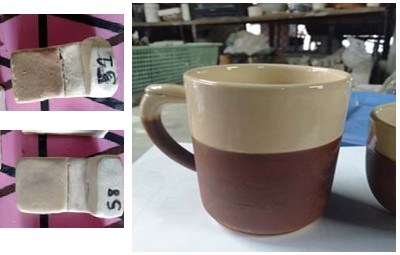
The objectives of this research are to study the chemical composition of laterite soil from San Pa Pao Sub-district, Doisaket District, Chiang Mai Province and to study the mixture rate of laterite soil, soda feldspar and Lampang Kaolin from Northern Chemicals and Glassware Co., Ltd. All 3 kinds of raw materials are coarsely grinded with a jaw Crusher and then ground in a masher. The chemical compositions of laterite soil were analyzed. All 3 kinds of raw materials which have been ground and sifted through a 325 mesh sieve were weighed according to the mixture ratio. Each ingredient was stirred in a stirring tank and workpieces were glazed with 66 formulations. The glazed workpieces was fired in an oxidation atmosphere with an electric furnace in the ceramics laboratory of the Ceramics Technology Program, Faculty of Science and Technology, Chiang Mai Rajabhat University. The analysis of chemical compositions of laterite soil were found light element 57%, 25.62% of silicon, 4.06% of iron and 3.81% of potassium. Of all 66 ceramic glaze formulations, it was found that there are 7 best and suitable formulations for glaze ceramics applications, which have the appearance of smooth, glossy, beautiful color, including formulation 21 is brown, formulation 38 and 54 are light brown, formulation 46 and 56 are gray, formulation 57 is dull gray, and formulation 58 is light gray.
References
GIDIGASU. “Pedogenesis and Engineering Principles”. Laterite Soil Engineering, Amsterdam, Netherlands, Elsevier Scientific Publishing Company, 1976.
สุภาพร สนิทวงศ์ชัย. “อิทธิพลของพลังงานบดอัดที่มีผลต่อดินลูกรัง.” วิทยานิพนธ์ปริญญาโทมหาวิทยาลัยเกษตรศาสตร์, กรุงเทพฯ. 2528.
KRINITZSKY. “Geology and Geotechnical Properties of Laterite Gravel.” Vicksburg, USA:US Army Engineering Water Way Experiment Station,1976.
สมบูรณ์ อรัณยภาค “หลักการทําเคลือบเซรามิก.” กรุงเทพฯ: สํานักพิมพ์แห่งจุฬาลงกรณ์มหาวิทยาลัย, 2553.
ปรีดา พิมพ์ขาวขํา. “เซรามิก.” กรุงเทพฯ: จุฬาลงกรณ์มหาวิทยาลัย, 2539.
วรพงษ์ เทียมสอน. “เซรามิกเพื่อการก่อสร้างและเซรามิกเพื่องานเทคนิค.” โอเดียนสโตร์. 2555.
ไพจิตร อิ่งศิริวัฒน์. “รวมสูตรเคลือบเซรามิก.” กรุงเทพฯ: โอเดียนสโตร์. 2537.
พรชัย ปานทุ่ง “การพัฒนาน้ําเคลือบเซรามิกจากเนื้อดินพื้นบ้าน.” Interdisciplinary Research Review [ออนไลน์] 2559 [สืบค้นเมื่อวันที่ 15 เมษายน 2563]. จาก https://ph02.tci-thaijo.org/index.php/jtir/articlee/view/45040.
กฤตยชญ์ คํามิ่ง, คะนึงนิต ปทถมมาเกษร. “การพัฒนาเคลือบเซรามิกขี้เถ้ามันสําปะหลัง จังหวัดกําแพงเพชร.” มหาวิทยาลัยราชภัฏวไลยอลงกรณ์ [ออนไลน์] 2559. [สืบค้นเมื่อวันที่ 15/4/2563].จาก https://so06.tci-thaijo.org/index.php/vrurdistjournal/issue/view/6740.
ไพจิตร อิ่งศิริวัฒน์. “สีเซรามิก.” กรุงเทพฯ: โอเดียนสโตร์. 2536.