
กำลังอัดและการดูดซึมน้ำจีโอพอลิเมอร์เถ้าลอยผสมเถ้าไม้ยางพารา
คำสำคัญ:
เถ้าลอย, เถ้าไม้ยางพารา, วัสดุประสาน, สารอัลคาไลน์, จีโอพอลิเมอร์บทคัดย่อ
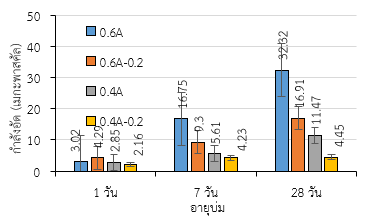
การศึกษานี้มีจุดประสงค์เพื่อศึกษาผลของอัตราส่วนสารละลายอัลคาไลน์ต่อตัววัสดุประสาน และการแทนที่เถ้าลอยด้วยเถ้าไม้ยางพาราต่อคุณสมบัติของจีโอพอลิเมอร์มอร์ต้าร์ โดยใช้อัตราส่วนสารอัลคาไลน์ต่อวัสดุประสานเท่ากับ 0.4, 0.6 และ 0.8 อัตราส่วนโซเดียมซิลิเกตต่อโซเดียมไฮดรอกไซด์ที่ 2.5 ใช้เถ้าไม้ยางพาราร้อย 0, 20, 40 และ 60 อัตราส่วนน้ำต่อวัสดุประสานเท่ากับ 0.2 และ 0.3 และอัตราส่วนทรายเท่ากับ 2.75, 3.00 และ 3.25 โดยน้ำหนักทุกส่วนผสม ใช้การบ่มที่อุณหภูมิห้อง 30±2 องศาเซลเซียส เป็นเวลา 24 ชม. ทดสอบกำลังอัดที่อายุ 1, 7 และ 28 วัน และการทดสอบการดูดซึมน้ำที่อายุ 28 วัน ผลการศึกษาพบว่าอัตราส่วนผสม 40P0.6A สามารถให้กำลังอัดสูงสุด 35.93 เมกะพาสคัล มีค่าการดูดซึมน้ำร้อยละ 0.88 ที่ระยะเวลาบ่มน้ำ 24 ชม. การเพิ่มปริมาณเถ้าไม้ยางพาราและทรายทำให้การดูดซึมน้ำเพิ่มขึ้น ในขณะที่การเพิ่มอัตราส่วนสารอัลคาไลน์มากขึ้นการดูดซึมน้ำลดลง การวิจัยนี้มีประโยชน์ด้านสิ่งแวดล้อมโดยช่วยลดการใช้ปูนซีเมนต์และนำของเสียจากชีวมวลกลับมาใช้ใหม่ในการผลิตวัสดุก่อสร้างที่มีความแข็งแรงและทนทาน
เอกสารอ้างอิง
M. Shamsah, R. Kalfat, and K. V. L. Subramaniam, “Impact of low NaOH molarities on mechanical and durability properties of ambient and oven-cured fly ash geopolymer concrete,” Journal of Building Engineering, vol. 105, 112491, 2025, doi.org/10.1016/j.jobe.2025.112491
I. Skyrianou, L. N. Koutas, and C. G. Papakonstantinou, “Metakaolin-based geopolymer mortars: Influence of mix design on mechanical properties and durability,” Construction and Building Materials, vol. 490, 142526, 2025, doi.org/10.1016/j.conbuildmat. 2025.142526
A. Hawa, W. Prachasaree, and D. Tonnayopas. “Effect of water-to-powder ratios on the compressive strength and microstructure of metakaolin based geopolymers,” Indian Journal of Engineering & Materials Sciences, vol. 14, 499-506, 2017.
A. Hawa, P. Salaemae, A. Abdulmatin, K. Ongwuttiwat, and W Prachasearee, “Properties of Palm Oil Ash Geopolymer Containing Alumina Powder and Field Para Rubber Latex,” Civil Engineering Journal, vol. 9, no. 5, 1271-1288, 2023, doi.org/10.28991/CEJ-2023-09-05-017
R. Wulandari, Meysara, Emiliana, Sunarno, D. Heltina, Khairat, and A. Amri, “Structural and physicomechanical properties of rice husk Ash-based geopolymer mortar with the addition of graphene nanosheets,” Materials today: Proceedings, vol. 87, part 2, pp. 70-78, 2023, doi.org/10.1016/j.matpr.2023.02.375
A. Akbar, F. Farooq, M. Shafique, F. Aslam, R. Alyousef, and H. Alabduljabbar, “Sugarcane bagasse ash-based engineered geopolymer mortar incorporating propylene fibers,” Journal of Building Engineering, vol. 33, 101492, 2021, doi.org/10.1016/j.jobe.2020. 101492
I. Aziz, M. I. U. Hassan, E. U. Haq, and W. Abbass, “Development of geopolymer foam concrete incorporating sugarcane bagasse ash and fly ash; 100% recycled and cement-less concrete,” Arabian Journal for Science and Engineering, vol. 48, pp. 5655–5665, 2023, doi.org/10.1007/s13369-022-07511-z
P. Nuaklong, K. Janprasit, and P. Jongvivatsakul, “Enhancement of strengths of high-calcium fly ash geopolymer containing borax with rice husk ash,” Journal of Building Engineering, vol. 40, 102762, 2021, doi.org/10. 1016/j.jobe.2021.102762
X. Liu, J. Jiang, H. Zhang, M. Li, Y. Wu, L. Guo, W. Wang, P. Duan, W. Zhang, and Z. Zhang, “Thermal stability and microstructure of metakaolin-based geopolymer blended with rice husk ash,” Applied Clay Science, vol. 196, 105769, 2020, doi.org/10.1016/j.clay.2020.105769
A. Hawa, D. Tonnayopas, and W. Prachasaree. “Performance evaluation of metakaolin based geopolymer containing parawood ash and oil palm ash blends,” Materials Science, vol. 20, no. 3, pp. 339-344, 2014, doi.org/10.5755/j01. ms.20.3.4543
S. Chelluri and N. Hossiney, “Performance evaluation of ternary blended geopolymer binders comprising of slag, fly ash and brick kiln rice husk ash,” Case Studies in Construction Materials, vol. 20, e02918, 2024, doi.org/10.1016/j.cscm.2024.e02918
G. F. Huseien, Z. Kubba, and S. K. Ghoshal, “Engineering attributes of ternary geopolymer mortars containing high volumes of palm oil fuel ash: impact of elevated temperature exposure,” Fire, vol. 6, no. 9, 340, 2023, doi.org/10.3390/fire6090340
N. Ranjbar, M. Mehrali, A. Behnia, U. J. Alengaram, and M. Z. Jumaat. “Compressive strength and microstructural analysis of fly ash/palm oil fuel ash based geopolymer mortar,” Materials and Designs, vol. 59, pp. 532-539, 2014, oi.org/10.1016/j.matdes.2014. 03.037
P. Nuaklong, P. Jongvivatsakul, T. Pothisiri, V. Sata, and P. Chindaprasirt, “Influence of rice husk ash on mechanical properties and fire resistance of recycled aggregate high-calcium fly ash geopolymer concrete,” Journal of Cleaner Production, vol. 252, 119797, 2020, doi.org/10.1016/j.jclepro.2019.119797
M. A. M. Rihan, R. O. Onchiri, N. Gathimba, and B. Sabuni. “Effect of sugarcane bagasse ash addition and curing temperature on the mechanical properties and microstructure of fly ash-based geopolymer concrete,” Open Ceramics, vol. 19, 100616, 2024, doi.org/10. 1016/j.oceram.2024.100616
O. A. Abdulkareem, M. B. Ramli, and J. C. Matthews, “Production of geopolymer mortar system containing high calcium biomass wood ash as a partial substitution to fly ash: An early age evaluation,” Composites Part B: Engineering, vol. 174, 106941, 2019, doi.org/10. 1016/j.compositesb.2019.106941
J. Bijeljic, N. Ristic, D. Grdic, and M. Pavlovic, “Possibilities of biomass wood ash usage in geopolymer mixtures,” Technical gazette, vol. 30 no. 1, 52-60, 2023, doi.org/10.17559/TV-20220215222503
K. Arunkumar, M. Muthukannan, and A. S. Kumar, “Cleaner environment approach by the utilization of low calcium wood ash in geopolymer concrete,” Applied Science and Engineering Progress, vol. 15 no. 1, 1-13, 2022, doi.org/10.14416/j.asep.2021.06.005
D. Tonnayopas, A. Hawa, W. Prachasaree, and P. Taneerananon, “Effect of parawood ash on drying shrinkage, compressive strength and microstructural characterization of metakaolin-based geopolymer mortar,” Key Engineering Materials, vol. 594-595, pp. 411-415, 2013, doi.org/10.4028/www.scientific.net/ KEM.594-595.411
ทวีศักดิ์ ทองขวัญ นันทชัย ชูศิลป์ จุฑามาศ ลักษณะกิจ, “กำลังคอนกรีตผสมเถ้าไม้ยางพาราสำหรับชิ้นส่วนโครงสร้างสำเร็จรูป,” การประชุมวิชาการวิศวกรรมโยธาแห่งชาติ ครั้งที่ 27, จังหวัดเชียงราย, 24-26 สิงหาคม 2565.
Standard Specification for Concrete Aggregates, ASTM C33/C33M, 2018.
Standard Test Method for Compressive Strength of Hydraulic Cement Mortars (Using 2-in. or [50 mm] Cube Specimens), ASTM C109/C109M, 2021.
สกลวรรณ ห่านจิตสุวรรณ์ ธนากร ภูเงินขำ ปริญญา จินดาประเสริฐ. อิทธิพลของความละเอียดเถ้าลอยแคลเซียมสูงต่อสมบัติของจีโอโพลิเมอร์เพสต์. วารสารวิจัยและพัฒนา มจธ. ปี 36, ฉบับ 4, หน้า 399-408. 2556.
A. Wardhono, Y. Risdianto, K. D. Handayani, N. Andajani, and D. W. Law, “The role of water-to-binder ratio on strength of fly ash geopolymer as sustainable green materials in supporting SDG 13,” International Conference on SDGs and Bibliometric Studies (ICoSBi 2025), 640, 01005, 15 August 2025.
I. Garcia-Lodeiro, A. Palomo, A. Fern´andez-Jim´enez, and D. E. Macphee. “Compatibility studies between N-A-S-H and C-A-S-H gels. Study in the ternary diagram Na2O–CaO–Al2O3–SiO2–H2O,” Cement and Concrete Research, vol. 41, no. 9, 923-931, 2011, doi.org/10.1016/j.cemconres.2011.05.006
C. C. Ban, P. W. Ken, M. Ramli, “The hybridizations of coal fly ash and wood ash for the fabrication of low alkalinity geopolymer load bearing block cured at ambient temperature,” Construction and Building Materials, vol. 88, pp. 41-55, 2015, doi.org/ 10.1016/j.conbuildmat.2015.04.020
อาบีเด็ง ฮาวา “สมบัติของคอนกรีตมวลรวมเบาหินพัมมิซผสมเถ้าลอยไม้ยางพาราและเถ้าแกลบ,” วิทยานิพนธ์ วิศวกรรมมหาบัณฑิต, สาขาวิศวกรรมโยธา, คณะวิศวกรรมศาสตร์, มหาวิทยาลัยนราธิวาสราชนครินทร์, 2551.
ดาวน์โหลด
เผยแพร่แล้ว
รูปแบบการอ้างอิง
ฉบับ
ประเภทบทความ
สัญญาอนุญาต
ลิขสิทธิ์ (c) 2025 วารสารวิทยาศาสตร์ประยุกต์ วิศวกรรม และเทคโนโลยี มนร.

อนุญาตภายใต้เงื่อนไข Creative Commons Attribution-NonCommercial-NoDerivatives 4.0 International License.
##default.contextSettings.thaijo.licenseTerms##


