กำลังอัด การดูดซึมน้ำ และปริมาณช่องว่างของมอร์ต้าร์เบาที่ใช้ หินพัมมิซแทนที่มวลรวมในปริมาณสูง
คำสำคัญ:
หินพัมมิซ, มอร์ต้าร์เบา, กำลังอัด, การดูดซึมของน้ำ, ปริมาณช่องว่างบทคัดย่อ
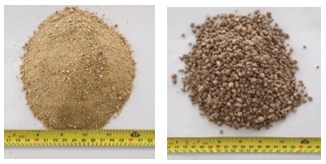
งานวิจัยนี้มีวัตถุประสงค์เพื่อศึกษาความเป็นไปได้ในการใช้หินพัมมิซเป็นมวลรวมในปริมาณสูงสำหรับผลิตเป็นมอร์ต้าร์เบา โดยแทนที่มวลรวมละเอียดด้วยหินพัมมิซในอัตราร้อยละ 0, 50, 75 และ 100 โดยน้ำหนัก ทำการทดสอบความต้องการน้ำของมอร์ต้าร์สด กำลังอัด สมบัติด้านการดูดซึมน้ำและปริมาณช่องว่างของมอร์ต้าร์ ผลการศึกษาพบว่า มอร์ต้าร์มีความต้องการน้ำเพิ่มขึ้นเมื่อแทนที่มวลรวมด้วยหินพัมมิซในอัตราส่วนที่มากขึ้น โดยมอร์ต้าร์ที่ใช้หินพัมมิซมีค่าอัตราส่วนน้ำต่อปูนซีเมนต์อยู่ระหว่าง 1.18 ถึง 1.54 ขณะที่มอร์ต้าร์ควบคุมมีค่าเท่ากับ 0.64 กำลังอัดของมอร์ต้าร์ที่แทนทรายด้วยหินพัมมิซมีค่าลดลงเมื่อแทนที่ในปริมาณมากขึ้น โดยการใช้หินพัมมิซในอัตราส่วนร้อยละ 50 สามารถพัฒนากำลังได้สูงสุด ซึ่งมอร์ต้าร์ PS50 มีค่ากำลังอัดเท่ากับ 112.2, 172.0 และ 178.7 กิโลกรัมต่อตารางเซนติเมตร ที่อายุ 7, 28 และ 60 วัน ตามลำดับ และสามารถใช้งานสำหรับโครงสร้างมวลเบาได้ตามมาตรฐาน ACI 213 การแทนที่ทรายด้วยหินพัมมิซส่งผลให้มอร์ต้าร์มีหน่วยน้ำหนักน้อยลงอย่างมีนัยสำคัญ เนื่องจากหินพัมมิซมีความถ่วงจำเพาะต่ำ ส่วนการดูดซึมน้ำของมอร์ต้าร์มีค่าเพิ่มขึ้นตามปริมาณการแทนที่มวลรวมด้วยหินพัมมัซและมีความสัมพันธ์โดยตรงกับปริมาณช่องว่าง
เอกสารอ้างอิง
M. R. Ali, M. Maslehuddin, M. Shameem, and M. S. Barry, “Thermal-resistant lightweight concrete with polyethylene beads as coarse aggregates,” Construction and Building Materials, vol. 164, pp. 739–749, March 2018.
F. A. Shaikh, P. Nath, A. Hosan, M. John, and W. K. Biswas, “Sustainability assessment of recycled aggregates concrete mixes containing industrial by-products,” Materials Today Sustainability, vol. 5, 100013, September 2019.
M. J. Shannag, A. Charif and S. Dghaither, “Developing structural lightweight concrete using volcanic scoria available in Saudi Arabia,” Arabian Journal for Science and Engineering, vol. 39, pp. 3525–3534, May 2014.
M. A. Idi, A. S. Abdulazeez, S. A. Usman and T. Justin, “Strength Properties of Concrete Using Pumice Aggregate As Partial Replacement of Coarse Aggregate,” International Journal of Engineering Applied Sciences and Technology, vol. 4, no. 11, pp. 519–525, March 2020.
S. Dueramae, S. Sanboonsiri, T. Suntadyon, B. Aoudta, W. Tangchirapat, P. Jongpradist, T. Pulngern. P. Jitsangiam and C. Jaturapitakkul, “Properties of lightweight alkali activated controlled Low-Strength material using calcium carbide residue–Fly ash mixture and containing EPS beads,” Construction and Building Materials, vol. 297, 123769, August 2021.
K. M. A. Hossain, “Properties of volcanic pumice based cement and lightweight concrete,” Cement and concrete research, vol. 34, no. 2, pp. 283–291, February 2004.
R. Şahin, R. Demirboğa, H. Uysal, and R. Gül, “The effects of different cement dosages, slumps and pumice aggregate ratios on the compressive strength and densities of concrete,” Cement and Concrete Research, vol. 33, no. 8, pp. 1245–1249, August 2003.
H. Ö. Öz, “Properties of pervious concretes partially incorporating acidic pumice as coarse aggregate,” Construction and building Materials, vol. 166, pp. 601-609, March 2018.
M. Golias, J. Castro, and J. Weiss, “The influence of the initial moisture content of lightweight aggregate on internal curing,” Construction and Building Materials, vol. 35, pp. 52-62, October 2012.
Standard Specification for Concrete Aggregates, ASTM C33/C33M-18, 2018.
Standard Test Method for Compressive Strength of Hydraulic Cement Mortars (Using 2-in. or [50 mm] Cube Specimens), ASTM C109/C109M-16a, 2016.
Testing concrete. Method for determination of water absorption, BS 1881-122, 2011.
K. M. A. Hossain, S. Ahmed, and M. Lachemi, “Lightweight concrete incorporating pumice based blended cement and aggregate: Mechanical and durability characteristics,” Construction and Building Materials, vol. 25, no. 3, pp. 1186–1195, March 2011.
P. Lura, D. P., Bentz, D. A. Lange, K. Kovler, A. Bentur, and K. Van Breugel, “Measurement of water transport from saturated pumice aggregates to hardening cement paste,” Materials and Structures, vol. 39, pp. 861–868, November 2006.
R. Henkensiefken, J. Castro, D. Bentz, T. Nantung, and J. Weiss, “Water absorption in internally cured mortar made with water-filled lightweight aggregate,” Cement and Concrete Research, vol. 39, no. 10, pp. 883–892, October 2009.
M. El-Hawary and A. Al-Sulily, “Internal curing of recycled aggregates concrete,” Journal of Cleaner Production, vol. 275, 122911, December 2020.
S. Zhutovsky and K. Kovler, “Influence of water to cement ratio on the efficiency of internal curing of high-performance concrete,” Construction and Building Materials, vol. 144, pp. 311-316, July 2017.
L. Gündüz, “The effects of pumice aggregate/cement ratios on the low-strength concrete properties,” Construction and Building Materials, vol. 22, no. 5, pp. 721–728, May 2008.
ACI 213 : Structural Lightweight-Aggregate Concrete, ACI 213, 2014.
ดาวน์โหลด
เผยแพร่แล้ว
รูปแบบการอ้างอิง
ฉบับ
ประเภทบทความ
สัญญาอนุญาต
ลิขสิทธิ์ (c) 2023 วารสารวิทยาศาสตร์ประยุกต์ วิศวกรรม และเทคโนโลยี มนร.

อนุญาตภายใต้เงื่อนไข Creative Commons Attribution-NonCommercial-NoDerivatives 4.0 International License.
##default.contextSettings.thaijo.licenseTerms##


