
A Study of Compressive Strength and Density of Pervious Geopolymer Concrete
Keywords:
Compressive-strength, Pervious-concrete, Bulk-density, GeopolymerAbstract
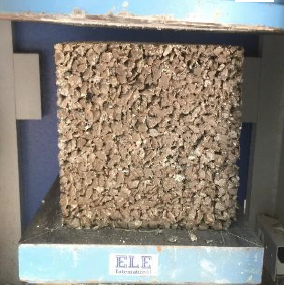
This research aims to study the compressive strength of geopolymer pervious concrete. The mix proportions were prepared with alkali solution to fly ash (AS/FA) ratios of 0.75, 1 and 1.25 by weight. The water to fly ash (W/FA) ratios of 0.3 and fly ash to stone (FA/ST) ratios of 1:8, 1:10, 1:12, 1:14 and 1:16 by weight. Testing the compressive strength of geopolymer pervious concrete were cured for a period of 28 days at ambient temperature compared to geopolymer pervious concrete were curing temperature at 80 °C for 1 hour. Further testing the compressive strength of pervious concrete were use Portland cement equal to the weight amount of fly ash and alkali solution combined. The results revealed that the compressive strength of specimens were cured in oven was lower than that of specimens were cured at ambient temperature. Compressive strength and bulk density of geopolymer pervious concrete tends to increase with increase of fly ash. However compressive strength are decreased when increased amount of alkali solution in the mix. (AS/FA) ratio of 0.75 gave the highest compressive strength. Compressive strength and bulk density of pervious concrete tends to increase with increase Portland cement replacement.
References
V. Sata, A. Wongsa, and P. Chindaprasirt, “Properties of pervious geopolymer concrete using recycled aggregates,” Construction and Building Materials, vol. 43, pp. 33-39, 2013. doi.org/10.1016/j.conbuildmat.2012.12.046.
Y. Zaetang, A. Wangsa, V. Sata, P. Chindaprasirt, “Use of coal ash as geopolymer binder and coarse aggregate in pervious concrete,” Construction and Building Materials, vol. 96, pp. 289-295, 2015. doi.org/10.1016/j.conbuild mat.2015.08.076.
Z. Sun, X. Lin, and A. Vollpracht, “Pervious concrete made of alkali activated slag and geopolymers,” Construction and Building Materials, vol. 189, pp. 797-803, 2018. doi.org/ 10.1016/j.conbuildmat.2018.09.067.
Standard Specification for Portland Cement, ASTM 150-4, 2004.
A. Hawa, P. Salaemae, S. Mama, Z. Dema, and W. Prachasaree, “Mechanical properties and microstructure of fly ash based geopolymer using crumb rubber as fine aggregate,” KMUTT Research & Development Journal, vol. 45, no. 1, pp. 125-144. (in Thai)
Testing hardened concrete Past 1: Shape, dimensions and other requirements for specimens and moulds, BS EN 12390-1, 2012.
Testing hardened concrete Past 2: Making and curing specimens for strength test, BS EN 12390-2, 2009.
Testing hardened concrete Past 3: Compressive strength of test specimens, BS EN 12390-3, 2009.
N. Mongkhpn, “Effect of cement to aggregate ratio and compaction effect on properties of pervious concrete made of ternary-sized gravel,” Engineering Journal Chiang Mai University, vol. 23, no. 2, pp. 60-66, 2016.
S. A. Arafa, A. Z. M. Ali, S. N. Rahmat, and Y. L. Lee, “Optimum mix for pervious geopolymer concrete (GEOCRETE) based on water permeability and compressive strength,” MATEC Web of Conferences vol. 103, 01024, 2017. doi.org/10.1051/matecconf/2017103010 24.
J. Temuujin, A. van Riessen, and K. J. D. MacKenzie, “Preparation and characterisation of fly ash based geopolymer mortars,” Construction and Building Materials, vol. 24, no. 10, pp. 1906–1910, 2010. doi.org/10.1016/j. conbuildmat.2010.04.012.
R. P. Williams and A. Van Riessen, “Determination of the reactive component of fly ashes for geopolymer production using XRF and XRD,” Fuel, vol. 89, no. 12, pp. 3683–3692, 2010. doi.org/10.1016/j.fuel.2010.07.031.
Y. Huang, M. Han, and R. Yi, “Microstructure and properties of fly ash-based geopolymeric material with 5A zeolite as a filler,” Construction and Building Materials, vol. 33, pp. 84–89, 2012. doi.org/10.1016/j.conbuild mat.2012.01.014.
T. Xie and T. Ozbakkaloglu, “Behavior of low-calcium fly and bottom ash-based geopolymer concrete cured at ambient temperature,” Ceramics International, vol. 41, pp. 5945-5958, 2015. doi.org/10.1016/j.cera mint.2015.01.031.
A. Hawa and W. Prachasaree, “Metakaolin Based Geopolymer,” Princess of Naradhiwas University Journal, vol. 8, no. 1, pp. 155-167, 2016. (in Thai)
Downloads
Published
How to Cite
Issue
Section
License

This work is licensed under a Creative Commons Attribution-NonCommercial-NoDerivatives 4.0 International License.
Articles in this journal are copyrighted by the x may be read and used for academic purposes, such as teaching, research, or citation, with proper credit given to the author and the journal.use or modification of the articles is prohibited without permission.
statements expressed in the articles are solely the opinions of the authors.
authors are fully responsible for the content and accuracy of their articles.
other reuse or republication requires permission from the journal."


