
Strength and Physical Properties of Cement Mortar Mixed with Field Para Rubber Latex
Keywords:
Concrete-block, Field-Para-rubber-latex, Mortar, Paving-blockAbstract
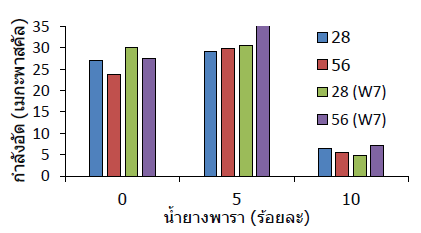
In This study aimed to improve the properties of ordinary Portland cement (OPC) mortars mixed with field Para rubber latex (FPRL). The cement mortars mixtures were prepared with the partial substation of OPC by FPRL of 5, 10, and 15 wt% and were cured in water and at ambient temperature. The samples were prepared with water to cement ratio at 0.4 by weight. The main parameters were studied of setting time, compressive strength, bulk density, water absorption, and compressive strength after submerge in seawater. The results show that the mortar sample with 5% FPRL and cured in water condition was the highest compressive strength to the other samples. The cement mortars containing FPRL can be used the concrete pavement, paving block and concrete block for construction materials.
References
S. W. M. Supit, F. U. A. Shaikh, and P. K. Sarker, “Effect of ultrafine fly ash on mechanical properties of high volume fly ash mortar,” Construction and Building Materials, vol, 51, pp. 278-286, 2014. doi.org/10.1016/j.conbuil dmat.2013.11.002.
Y. K. Cho, S. H. Jung, and Y. C. Choi, “Effects of chemical composition of fly ash on compressive strength of fly ash cement mortar,” Construction and Building Materials, vol. 204, pp. 255-264, 2019. doi.org/10.1016/ j.conbuildmat.2019.01.208.
K. Bazzar, F. Z. Hafiane, and A. H. Alaoui, “The early age strength improvement of the high volume fly ash mortar,” Civil Engineering Journal, vol. 7, no. 8, pp. 1378-1388, 2021. doi.org/10.28991/cej-2021-03091731.
P. Chindaprasirt, and S. Rukzon, “Strength and chloride resistance of the blended Portland cement mortar containing rice husk ash and ground river sand,” Materials and Structure, vol. 48, no. 11, pp. 3771-3777, 2015. doi.org/ 10.1617/s11527-014-0438-9.
M. Zahedi, A. A. Ramezanianpour, and A. M. Ramezanianpour, “Evaluation of the mechanical properties and durability of cement mortars containing nanosilica and rice husk ash under chloride ion penetration,” Construction and Building Materials, vol. 246, 119142, 2015. https://doi.org/10.1016/j.con buildmat.2015.01.045.
K. Selvaranjan, J. C. P. H. Gamage, G. I. P. De Silva, and S. Navaratnam, “Development of sustainable mortar using waste rice husk ash from rice mill plant: Physical and thermal properties,” Journal of Building Engineering, vol. 43, 102614, 2021. doi.org/10.1016/j.jobe. 2021.102614.
S. Rukzon and P. Chindaprasirt, “Strength and chloride penetration of Portland cement mortar containing palm oil fuel ash and ground river sand,” Computers and Concrete, vol. 6, no. 5, pp. 391-401, 2009. doi.org/10. 12989/cac.2009.6.5.391.
S. Y. Kong, Z. H. See, C. L. Lee, X. Yang, L. S. Wong, and T. S. Goh, “Thermal and mechanical properties of mortar incorporated with paraffin/palm oil fuel ash composite,” Journal of Building Engineering, vol. 26, 100923, 2019. doi.org/10.1016/j.jobe.2019. 100923.
S. K. Tulashie, S. Dapaah, D. Mensah, and N. Appiah, “Palm fiber ash as a supplementary cementitious material for the production of mortar prism,” Innovative Infrastructures Solutions, vol. 7, 3, doi.org/10.1007/s41062-021-00602-0.
C. B. Cheah, W. K. Part, and M. Ramli, “The long term engineering properties of cementless building block work containing large volume of wood ash and coal fly ash,” Construction and Building Materials, vol. 143, pp. 522-536, 2017. doi.org/10.1016/j.conbuild mat.2017.03.162.
M. E. Rahman, A. L. Boon, A. S. Muntohar, M. N. H. Tanim, and V. Pakrashi, “Performance of masonry blocks incorporating palm oil fuel ash,” Journal of Cleaner Production, vol. 78, pp. 195-201, 2014. doi.org/10.1016/j.jclepro. 2014.04.067.
Research and Development of Rubber Economy, (2021, November 20) Rubber Authority of Thailand, www.raot.co.th
P. Plangoen, S. Chinvikkai, and C. Chuntavan, “The development of mortar mixed with rubber latex for lrrigation canal maintenance,” KMUTT Research and Development Journal, vol. 41, no. 2, pp. 211-223, 2018. (in Thai)
C. Traiyasut, “A Study setting time, workability and compressive strength of concrete mixed by natural rubber for pavement repairs,” Technical Education Journal: King Mongkut’s University of Technology North Bangkok, vol. 12, no. 2, pp. 91-101, 2021. (in Thai)
Standard Specification for Portland Cement, ASTM 150-4, 2004.
Standard Specification for Concrete Aggregates, ASTM C33/C33M-13, 2013.
Knowledge Management, “Knowledge of latex and component in latex,” Rubber Authority of Thailand, www.raot.co.th (accessed: November 27, 2021)
D. C. Blackley, Polymer Latices, Science and Technology, Type of Latices Chapter 9 Natural Latices. Chapman & Hall, 1997.
Standard Test Methods for Time of Setting of Hydraulic Cement by Vicat Needle. ASTM C191-13, 2013.
Standard Test Method for Compressive Strength of Hydraulic Cement Mortars (Using 2-in. or [50-mm] Cube Specimens). ASTM C109/C109M-16a, 2016.
S. Subash, K. M. Mini, M. Ananthkumar, “Incorporation of natural rubber latex as concrete admixtures for improved mechanical properties,” Materials Today: Proceeding, vol. 46, no. 10, pp. 4859-4862, 2021. doi.org/10. 1016/j.matpr.2020.10.326.
C. Prachoom, (2007). “Use of Para-rubber to improve strength and insulation properties of autoclaved aerated lightweight concrete,” KMUTT Research and Development Journal, vol. 30, no. 2, pp. 363-376, 2007. (in Thai)
Downloads
Published
How to Cite
Issue
Section
License
Copyright (c) 2022 วารสารวิทยาศาสตร์ประยุกต์ วิศวกรรม และเทคโนโลยี มนร.

This work is licensed under a Creative Commons Attribution-NonCommercial-NoDerivatives 4.0 International License.
Articles in this journal are copyrighted by the x may be read and used for academic purposes, such as teaching, research, or citation, with proper credit given to the author and the journal.use or modification of the articles is prohibited without permission.
statements expressed in the articles are solely the opinions of the authors.
authors are fully responsible for the content and accuracy of their articles.
other reuse or republication requires permission from the journal."


