
Automatic Vehicle License Plate Recognition System Using Computer Vision
Keywords:
Automatic license plate recognition, Image processing, Deep learning, Optical character recognitionAbstract
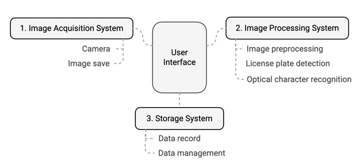
This research presents the development of an Automatic License Plate Recognition (ALPR) system for Thai license plates using YOLOv8 model for license plate detection and Tesseract OCR for character recognition. The developed system consists of five main components: data preparation, image pre-processing, license plate detection, character recognition and user interface and software development. The system was tested using a dataset of 791 Thai license plate images. The experimental findings indicated a license plate detection accuracy of 92%, accompanied by character recognition accuracies of 80% for white-background plates and 50% for graphic-background plates. The system can be applied in traffic management, automated parking systems, and security systems. However, the system's performance is dependent on environmental factors such as lighting conditions, camera angles, and license plate conditions.
References
W. Weihong and T. Jiaoyang, “Research on License Plate Recognition Algorithms Based on Deep Learning in Complex Environment,” IEEE Access, vol. 8, pp. 91661–91675, 2020, doi: 10.1109/ACCESS.2020.2994287.
C. N. E. Anagnostopoulos, “License Plate Recognition: A Brief Tutorial,” IEEE Intelligent Transportation Systems Magazine, vol. 6, no. 1, pp. 59–67, 2014, doi: 10.1109/MITS.2013. 2292652.
M. M. Khan, M. U. Ilyas, I. R. Khan, S. M. Alshomrani, and S. Rahardja, “License Plate Recognition Methods Employing Neural Networks,” IEEE Access, vol. 11, pp. 73613–73646, 2023, doi: 10.1109/ACCESS.2023.3254 365.
V. Jain, Z. Sasindran, A. Rajagopal, S. Biswas, H. S. Bharadwaj, and K. R. Ramakrishnan, “Deep automatic license plate recognition system,” in Proceedings of the Tenth Indian Conference on Computer Vision, Graphics and Image Processing, in ICVGIP ’16. New York, NY, USA: Association for Computing Machinery, 2016. doi: 10.1145/3009977.3010052.
J. Shashirangana, H. Padmasiri, D. A. Meedeniya, and C. Perera, “Automated License Plate Recognition: A Survey on Methods and Techniques,” IEEE Access, vol. 9, pp. 11203–11225, 2021, [Online]. Available: https://api.semanticscholar.org/CorpusID:231684908
F. Jalled and I. Voronkov, “Object Detection using Image Processing,” ArXiv, vol. abs/1611.07791, 2016, [Online]. Available: https://api.semanticscholar.org/CorpusID:18547809
M. Cheng and M. Liu, “Image convolution techniques integrated with YOLOv3 algorithm in motion object data filtering and detection,” Sci Rep, vol. 14, 2024, [Online]. Available: https://api.semanticscholar.org/CorpusID:268854218
Y. Wang, Y. Lu, and Y. Qiu, “Gated image-adaptive network for driving-scene object detection under nighttime conditions,” Multimed Syst, 2024, [Online]. Available: https://api.semanticscholar.org/CorpusID:274970201
I. B. Barbosa et al., “Progressive structural deterioration of an endodontic instrument – A preliminary micro-computed tomography study,” Eng Fail Anal, 2019, [Online]. Available: https://api.semanticscholar.org/CorpusID:189994589
S. M. Al Jaberi, A. Patel, and A. N. Al Al-Masri, “Object tracking and detection techniques under GANN threats: A systemic review,” Appl. Soft Comput., vol. 139, p. 110224, 2023, [Online]. Available:https://api.semanticscho lar.org/CorpusID:257723430
G. A. Robby, A. Tandra, I. Susanto, J. Harefa, and A. Chowanda, “Implementation of Optical Character Recognition using Tesseract with the Javanese Script Target in Android Application,” in International Conference on Computer Science and Computational Intelligence, 2019. [Online]. Available: https:// api.semanticscholar.org/CorpusID:208115880
A. M. Vizitiu, M. A. Sandu, L. Dobrescu, A. Focsa, and C. Molder, “Comparative Approach to De-Noising TEMPEST Video Frames,” Sensors (Basel), vol. 24, 2024, [Online]. Available: https://api.semanticscholar.org/Cor pusID:273014983
M. D. Alahmadi and M. Alshangiti, “Optimizing OCR Performance for Programming Videos: The Role of Image Super-Resolution and Large Language Models,” Mathematics, 2024, [Online]. Available: https://api.semanticscho lar.org/CorpusID:268832542
S. M. Silva and C. R. Jung, “A Flexible Approach for Automatic License Plate Recognition in Unconstrained Scenarios,” IEEE Transactions on Intelligent Transportation Systems, vol. 23, no. 6, pp. 5693–5703, 2022, doi: 10.1109/TITS. 2021.3055946.
F. Sultan, K. Khan, Y. A. Shah, M. Shahzad, U. Khan, and Z. Mahmood, “Towards Automatic License Plate Recognition in Challenging Conditions,” Applied Sciences, vol. 13, no. 6, 2023, doi: 10.3390/app13063956.
R. Zibani, F. Sebbak, M. E. Y. Boudaren, M. Mataoui, R. Hadj Aissa, and Y. A. Benaissa, “Multi-attribute fusion-based approach for Algerian automatic license plate recognition,” Multimed Tools Applied, vol. 83, no. 10, pp. 30233–30259, 2024, doi: 10.1007/s11042-023-16789-6.
U. Saha, B. Saha, and M. A. Imran, “A Weather-Adaptive Convolutional Neural Network Framework for Better License Plate Detection,” Sensors, vol. 24, no. 23, 2024, doi: 10.3390/s24237841.
T. M. Al-Hasan, V. Bonnefille, and F. Bensaali, “Enhanced YOLOv8-Based System for Automatic Number Plate Recognition,” Technologies (Basel), vol. 12, no. 9, 2024, doi: 10.3390/technologies12090164.
Y. Tang, S. Zhang, W. Liu, Z. Wang, and J. Wang, “Ultra-Lightweight Automatic License Plate Recognition System for Microcontrollers: A Cost-Effective and Energy-Efficient Solution,” IEEE Transactions on Intelligent Transportation Systems, vol. 25, no. 12, pp. 20419–20434, 2024, doi:10.1109/TITS.2024. 3480039.
X. Ke, G. Zeng, and W. Guo, “An Ultra-Fast Automatic License Plate Recognition Approach for Unconstrained Scenarios,” IEEE Transactions on Intelligent Transportation Systems, vol. 24, no. 5, pp. 5172–5185, 2023, doi: 10.1109/TITS.2023.3237581.
Downloads
Published
How to Cite
Issue
Section
License
Copyright (c) 2025 วารสารวิทยาศาสตร์ประยุกต์ วิศวกรรม และเทคโนโลยี มนร.

This work is licensed under a Creative Commons Attribution-NonCommercial-NoDerivatives 4.0 International License.
Articles in this journal are copyrighted by the x may be read and used for academic purposes, such as teaching, research, or citation, with proper credit given to the author and the journal.use or modification of the articles is prohibited without permission.
statements expressed in the articles are solely the opinions of the authors.
authors are fully responsible for the content and accuracy of their articles.
other reuse or republication requires permission from the journal."


