Mechanical Properties of Cement Mortar using Plastic Waste-Coated Coarse Palm Oil Fuel Ash Replaced Fine Aggregate
Keywords:
Coarse palm oil fuel ash, Plastic, Absorption rate, Compressive strengthAbstract
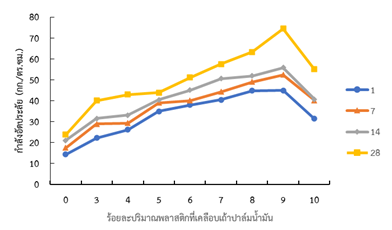
This study examines the properties of mortars containing coarse palm oil fuel ash with a plastic coating instead of sand. The properties investigated include the compressive strength of the mortar and its water absorption capacity. In addition, the effects of the water absorption of coated coarse palm oil fuel ash with different ratios and the effects of water absorption on the compressive strength of the mortar were investigated. The water-to-binder ratio used in mortar casting is based on the increased table flow rate of 110 ± 5% of the original diameter. Coarse palm oil fuel ash coatings with a plastic weight ratio of 0, 3, 4, 5, 6, 7, 8, 9 and 10%. The coated samples were tested for water absorption. The coarse palm oil fuel ash was then mixed in various ratios to form 5x5x5 cm cubic mortar samples. The samples were cured for 7, 14 and 28 days to allow the hydration reaction to be completed before compressive strength testing. When testing the water absorption capacity, it was found that the higher the percentage of plastic in relation to the weight of the coarse palm oil fuel ash, the lower the water absorption. However, when compared with the results of the compressive strength test, it was found that the mortar achieved the highest compressive strength at a plastic content of 9 of the coarse palm oil fuel ash weight, although still less than the control mortar. At 10% plastic content of the coarse palm oil fuel ash weight, the compressive strength began to decrease, possibly due to the excessive plastic content.
References
M. A. Mannan and C. Ganapathy, “Mix design for oil palm shell concrete,” Cement and Concrete Research, vol. 31, no. 9, pp. 1323–1325, September 2001.
เผ่าพงศ์ นิจจันทร์พันธ์ศรีและประชุม คำพุฒ, “การใช้หินฝุ่นแทนทรายในงาน คอนกรีตผสมเถ้าลอย,” รายงานการวิจัย, คณะวิศวกรรมศาสตร์, มหาวิทยาลัยเทคโนโลยีราชมงคลธัญบุรี, กรุงเทพฯ, 2550.
ชูเกียรติ ชูสกุล และ ขวัญชีวา หยงสตาร์, “กำลังอัดของมอร์ตาที่ใช้หินฝุ่นแทนทราย,” วารสารวิจัยมหาลัยเทคโนโลยีราชมงคลศรีวิชัย, ปีที่ 10, ฉบับ 2, หน้า 334-332, พฤษภาคม - สิงหาคม 2561.
อุดมวิทย์ ไชยสกุลเกียรติ และ อรรถพล มาลัย, “การพัฒนากำลังอัดมอร์ตาร์ผสมเถ้าถ่านหินและหินฝุ่น,” วารสารวิชาการพระจอมเกล้าพระนครเหนือ, ปีที่ 26, ฉบับที่ 1, หน้า 13-18, มกราคม-เมษายน 2561.
สุรชัย โกเมนธรรมโสภณ, “การศึกษากำลังอัดของคอนกรีตที่ใช้ฝุ่นแกรนิตคัดขนาดส่วนผสมแทนทรายกรณีศึกษา,” วารสารมหาวิทยาลัยนราธิวาสราชนครินทร์, ปีที่ 5, ฉบับที่ 1, หน้า 49-60, มกราคม-เมษายน 2556.
วรัญ วงศ์ประชุม และอิทธิพล มีผล, “คุณสมบัติเชิงกลของคอนกรีตผสมเม็ดยางเคลือบด้วยพลาสติก,” วารสารวิชาการเทคโนโลยีอุตสาหกรรม, มหาวิทยาลัยราชภัฎสวนสุนันทา, ปีที่ 6, ฉบับที่ 1, หน้า 39-45, มกราคม-มิถุนายน 2561.
Standard Specification for Concrete Aggregates, ASTM C33/C33M-18, 2018.
Standard Test Method for Sieve Analysis of Fine and Coarse Aggregates, ASTM C136-06, 2006.
Standard Test Method for Relative Density (Specific Gravity) and Absorption of Fine Aggregate, ASTM C128-15, 2015.
Standard Test Methods for Sampling and Testing Concrete Masonry Units and Related Units, ASTM C140/C140M-23, 2023.
Downloads
Published
How to Cite
Issue
Section
License
Copyright (c) 2024 วารสารวิทยาศาสตร์ประยุกต์ วิศวกรรม และเทคโนโลยี มนร.

This work is licensed under a Creative Commons Attribution-NonCommercial-NoDerivatives 4.0 International License.
Articles in this journal are copyrighted by the x may be read and used for academic purposes, such as teaching, research, or citation, with proper credit given to the author and the journal.use or modification of the articles is prohibited without permission.
statements expressed in the articles are solely the opinions of the authors.
authors are fully responsible for the content and accuracy of their articles.
other reuse or republication requires permission from the journal."


