
Using of Microbubbles Generator for Biodiesel Purification
Keywords:
Biodiesel-purification, Microbubble-generator, MicrobubbleAbstract
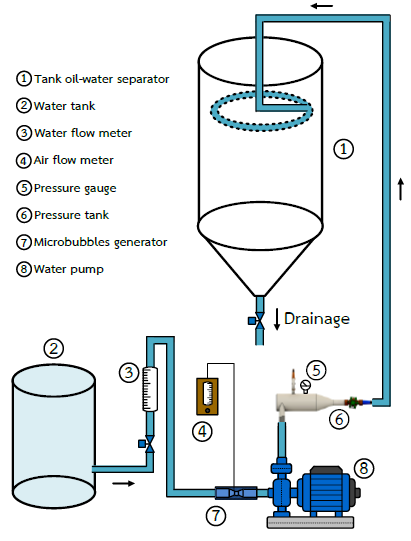
This research was related to apply the microbubble generator to purify the crude biodiesel that was synthesized from the chemical reaction which aim to remove some impurities and decrease the biodiesel pH for diesel engine. The study was performed with water spray from 2 positions which was from the top and bottom of biodiesel chamber, the separation of the biodiesel and water was allowed by placing for 10, 20 and 30 mins, the biodiesel were cleaned in several times and the biodiesel pH were detected. It was found that there was no effect of water spray position on biodiesel pH. For the first time cleaning, placing biodiesel for 30 mins caused to decrease the pH significantly. While, more than one time biodiesel cleaning with every placing time has no effect on biodiesel pH. However, biodiesel that was cleaned with water spray for six times were still base. The microbubble generator was applied to produce the microbubble water for biodiesel cleaning using pressure tank to control the microbubble size with the pressure at 0, 2, 4 and 6 Kg/cm2. It was revealed that the biodiesel that was cleaned with 4 Kg/cm2 of pressure treated microbubble water had the lowest pH and was able to neutralize pH after cleaning only two times, whereas the pH of microbubble water after cleaning was the highest. The electric power used for the microbubble generator was similar at all pressure levels.
References
กรมพัฒนาพลังงานทดแทนและอนุรักษ์พลังงาน กระทรวงพลังงาน, แผนปฏิบัติการอนุรักษ์พลังงาน 5 ปี (พ.ศ. 2560-2564), กรุงเทพฯ: กระทรวงพลังงาน, 2559.
สำนักงานคณะกรรมการพัฒนาการเศรษฐกิจและสังคมแห่งชาติ, แผนพัฒนาเศรษฐกิจและสังคมแห่งชาติ ฉบับที่ 12 (พ.ศ. 2560-2564), กรุงเทพฯ: สำนักนายกรัฐมนตรี, 2560.
สำนักงานนโยบายและแผนพลังงาน, กระทรวงพลังงาน, รายงานสถิติพลังงานของประเทศไทย 2564. กรุงเทพฯ: กระทรวงพลังงาน, 2564.
กำหนดลักษณะและคุณภาพของไบโอดีเซลประเภทเมทิลเอสเตอรของกรดไขมัน, ราชกิจจานุเบกษา. เล่ม 136 ตอนพิเศษ 123 ง, กรมธุรกิจพลังงาน, กระทรวงพลังงาน, 2562.
อมราภรณ์ แก้วชะฎา และ ธนพร ไวพานิชการ, (2558). “การเพิ่มความบริสุทธิ์ไบโอดีเซลที่สังเคราะห์จากน้ำมันปาล์ม โดยการล้างด้วยเครื่องปฏิกรณ์แบบช่องจุลภาค,” วารสารวิชาการพระจอมเกล้าพระนครเหนือ, ปีที่ 25, ฉบับที่ 1, หน้า 127-135, 2558. dx.doi.org/10.14416/j.kmutnb.2014.10.001.
อโนทัย สุธีรยงประเสริฐ, กำพล ประทีปชัยกูร และธีระยุทธ หลีวิจิตร, “ปริมาณการใช้น้ำในการท้าความสะอาดไบโอดีเซลในแบบกะโดยการสเปรย์น้ำ ร่วมกับการผสมด้วยฟองอากาศ,” การประชุมวิชาการเครือข่ายวิศวกรรมเครื่องกลแห่งประเทศไทยครั้งที่ 22. มหาวิทยาลัยธรรมศาสตร์ ศูนย์รังสิต, 2551.
C. Liu, T. Hiroshi, J. Zhang, L. Zhang, J. Yang, X. Huang, and N. Kubota, “Successful application of Shirasu porous glass (SPG) membrane system for microbubble aeration in a biofilm reactor treating synthetic wastewater,” Separation and Purification Technology, vol. 103, pp. 53-59, 2013. doi.org/10.1016/j.seppur. 2012.10.023.
A. Agarwal, W. J. Ng, and Y. Liu, “Principle and applications of microbubble and nanobubble technology for water treatment,” Chemosphere, vol. 84, no. 9, pp. 1175-1180, 2011. doi.org/10.1016/j.chemosphere.2011.05. 054.
H. Onari, T. Saga, K. Watanabe, K. Maeda, and K. Matsuo, “High functional characteristics of micro-bubbles and water purification,” Resources Processing, vol. 46, no. 4, pp. 238-244, 1999. doi.org/10.4144/ rpsj1986.46.238.
K. Terasaka, A. Hirabayashi, T. Nishino, S. Fujioka, and D. Kobayashi, “Development of microbubble aerator for waste water treatment using aerobic activated sludge,” Chemical Engineering Science, vol. 66, no. 14, pp. 3172-3179, 2011. doi.org/10.1016/j.ces. 2011.02.043.
Y. Nakatake, S. Kisu, K. Shigyo, T. Eguchi, and T. Watanabe, “Effect of nano air-bubbles mixed into gas oil on common-rail diesel engine,” Energy, vol. 59, no. 15, pp. 233-239, 2013. doi.org/10.1016/j.energy.2013.06.065.
สุธิดา ตีระธัญญา, “ผลของความดันในถังอัดความดันต่อประสิทธิภาพของระบบบำบัดตะกอนขั้นต้นโดยใช้การลอยตัวด้วยอากาศละลายสำหรับน้ำเสียโรงงานอิเล็กทรอนิกส์,” วิทยานิพนธ์ (วศ.ม.), จุฬาลงกรณ์มหาวิทยาลัย, กรุงเทพฯม, 2546.
แสงนวล ศรีรัตน์ชัชวาล และ อนุรักษ์ ปีติรักษ์สกุล, “กระบวนการลอยตะกอนแบบอากาศละลาย. วารสารวิชาการพระจอมเกล้าพระนครเหนือ,” ปีที่ 27, ฉบับที่ 1 หน้า 205-217, 2560. doi.org/10. 14416/j.kmutnb.2016.11.001.
M. Takahashi, K. Chiba, and P. Li, (2007). “Free-radical generation from collapsing microbubbles in the absence of a dynamic stimulus,” The Journal of Physical Chemistry B, vol. 111, no. 6, pp. 1343-1347, 2007. doi.org/ 10.1021/jp0669254.
Downloads
Published
How to Cite
Issue
Section
License
Copyright (c) 2022 วารสารวิทยาศาสตร์ประยุกต์ วิศวกรรม และเทคโนโลยี มนร.

This work is licensed under a Creative Commons Attribution-NonCommercial-NoDerivatives 4.0 International License.
Articles in this journal are copyrighted by the x may be read and used for academic purposes, such as teaching, research, or citation, with proper credit given to the author and the journal.use or modification of the articles is prohibited without permission.
statements expressed in the articles are solely the opinions of the authors.
authors are fully responsible for the content and accuracy of their articles.
other reuse or republication requires permission from the journal."


